Best Feminine Nose Shape: What Makes a Nose Look Feminine?

In short
A feminine nose usually has a soft bridge, a refined tip with gentle rotation and a size in proportion to the face; it is not simply the smallest nose. "Feminine" is a proportion, not a template, and must suit your face shape, ethnic features, skin and cartilage.
What Is the Best Feminine Nose Shape, and What Makes It "Feminine"?
A feminine nose is usually built from three things: a bridge with a soft line and no sharp angle, a refined tip rotated slightly upward, and a size that does not dominate the face. These are not a fixed template; the best shape is the one that stays in harmony with your own face. This article is educational and does not replace an in-person examination.
"Feminine" does not come from any single part, but from how the parts relate: tip rotation alone does not make a nose feminine if the bridge is too narrow or the size does not match the face. Below: how bridge, tip and width build that relationship, how the common styles differ, what face shape and ethnic features change, and where over-feminising a nose becomes artificial.
Is "Feminine" a Fixed Template or a Proportion?

A feminine nose is a proportion, not a template: the size of the nose relative to the face, the softness of the bridge line and the degree of tip rotation together define it. That is why one nose cannot suit every woman; what looks feminine on one face can look out of scale on another.
A review of the "10-7-5" nasal analysis method stresses that preoperative analysis should aim for changes that keep gender and ethnic congruency (PubMed — Evidence-based Nasal Analysis for Rhinoplasty: The 10-7-5 Method). A paper on Middle Eastern rhinoplasty likewise aims for a racially congruent outcome with an individualised approach (PubMed — Rhinoplasty in Middle Eastern Patients). A feminine nose that is natural on one facial structure can look foreign on another.
What Should the Bridge Look Like?

The bridge of a feminine nose usually has a soft line without a sharp prominence: straight or very slightly concave, blending gradually into the root. A hump or sharp angle makes the profile look stronger, but not every feminine nose lacks a hump, and removing every curve is not necessary.
Softening or removing a hump
If there is a hump, the goal is usually not complete removal but softening the line until it agrees with the tip and root. On noses with a bony hump this is done by shaving the bone and sometimes reshaping the bony roof. The details are in the article on bony noses.
The root and its relation to the forehead
A very low root flattens the profile and shortens the nose; a very high one makes the eyes look closer. For a feminine nose a root at a natural level with a gentle dip is often preferred so the profile stays soft and readable.
Tip and Rotation: Where Refined Becomes Too Much

A refined tip with gentle rotation is the most recognisable sign of a feminine nose, but it has limits: too much rotation exposes the nostrils from the front and makes the profile artificial. The aim is a tip that is soft and lifted above a drooping position, not one that looks pulled.
- Gentle rotation: the tip is slightly upturned and makes an open, natural angle with the upper lip.
- Over-rotation: the nostril openings show from the front and the space between nose and upper lip looks long.
- A drooping tip: the opposite, usually linked to a heavier or older look.
The tip is the most decisive part and the most sensitive to skin and cartilage: a refined tip on thick skin and weak cartilage is not achievable without structural support, which we explain in the article on fleshy noses.
How Large and How Wide Should the Nose Be?

A feminine nose is not the smallest possible nose but one whose width and length fit the face: from the front the nostril wings are not too wide, and in profile the length balances with the chin and forehead. A very tiny nose on a large face looks less balanced than a slightly bigger one.
Surgeons judge this in frontal, profile and basal views. The "right" size has no fixed number; it varies with eye distance, cheek width and chin position. A recessed chin makes the nose look bigger than it is, and reducing the nose alone does not correct that, a point also covered in our article on heart and diamond faces.
How Do the Common Feminine Styles Differ?

Three common feminine styles sit on one spectrum: refined natural makes the least change, semi-fancy a moderate one, and fantasy or doll the most. The further you go towards fantasy, the more "feminine" becomes a style rather than a proportion, and the more visible the limits and risks.
| Style | Bridge | Tip | Suits |
|---|---|---|---|
| Refined natural | Straight or slightly concave | Refined, gentle rotation | Most faces |
| Semi-fancy | More concave | Smaller, more rotation | Thin to medium skin |
| Fantasy / doll | Curved and narrow | Very small and lifted | Thin skin and firm cartilage |
A doll nose is not the same as "most feminine"; it is one point on a spectrum and is not achievable on many noses. Its limits are in the article on the doll nose, and the criteria for choosing among the three are in natural versus fantasy: how to decide.
How Does Face Shape Change the Choice?

There is no single feminine nose for every face shape; the same refined tip has a different effect on round, long, square and heart faces. The test is the balance between the nose and the widest and narrowest parts of the face, not copying a template.
- Round face: a slightly longer, more refined nose elongates the profile; see the round face article.
- Long face: a very long nose lengthens the face further; see the long and thin face article.
- Square face and wide jaw: a very small nose contrasts with the jaw; see the square face article.
- Heart and diamond faces: a refined but not tiny tip; see the heart and diamond article.
The View From Below: Columella, Nostrils and Alae
From below, a feminine nose usually has symmetric, roughly oval nostrils, a columella that sits neither too low nor too high, and alae whose width fits the bridge. This view is rarely discussed, yet in everyday photos and low-angle selfies it is the first thing that gives a nose away.
- The columella: one that hangs too low makes the tip look heavy; one that retracts too high makes the nose short and stiff.
- Nostril shape: symmetry matters more than exact shape; mild asymmetry is normal in many noses, but marked asymmetry after surgery can be bothersome. Our article on nostril asymmetry after rhinoplasty explains causes and timing.
- The alae: very wide alae make the nose look large from the front, while over-narrowed ones can constrict breathing, so the goal is not "the smallest ala possible".
These parts often get skipped in simple "feminine nose" articles, because planning a nose starts with profile and front view and ends with the view from below.
The Feminine Profile and the Nose-Lip-Chin Relationship
A feminine profile is not only the nose; it is the nose in relation to the upper lip and chin. A tip that rises too far makes the upper lip look long, and a small nose beside a recessed chin makes the chin look further back. The nose-lip-chin triangle is what makes a profile soft or heavy.
For that reason, comparing one nose photo to another without considering lip and chin is misleading. Two identical noses can look feminine on one profile and out of balance on another. If the chin is small or recessed, part of the "size" of the nose belongs to it, and reducing the nose further is not the answer. Dr. Salmani does not perform jaw or chin bone surgery; if examination shows the chin is the source, that is said plainly so the nose is not over-reduced.
Time and the Feminine Nose: Today's Result, the Face in a Few Years
A nose changes after surgery: swelling takes months to settle, and in later years, as soft tissue loosens, the tip may sit slightly lower. A very lifted tip today may look more natural later, but a tip that was made too small cannot be enlarged afterwards.
- The first months: the result is not accurate because of swelling; the tip and thicker skin settle later.
- Later years: the profile may soften slightly, which is why surgeons often suggest a more conservative choice than "maximum rotation".
- Changing taste: our idea of "feminine" shifts; a structure in harmony with your face and age dates less.
Our recovery articles, such as fever after rhinoplasty and sneezing and nose blowing after surgery, walk through healing step by step.
What Should Stay Away From the "Stereotypical Feminine" Nose?
Over-feminising a nose carries three risks: an over-lifted tip that exposes the nostrils, a very narrow bridge out of scale with the face, and over-reduction that may narrow the airway. Fashions change, but the structure of the nose after surgery does not revert.
Fashion versus durability
A trend that is current today can look dated in a few years, while the surgical result stays with you. A decision that survives a change of fashion is usually one that fits your face and skin.
Breathing
The nose is not just a shape; it is an airway. An over-reduced nose or an over-lifted tip may affect breathing. Pre-operative assessment looks at breathing as well as appearance, because comfortable breathing is part of a good result, not separate from it.
Revision
Removing too much cartilage and bone is generally not reversible, and revising an over-reduced nose is harder than refining a slightly larger one. Being conservative at the first operation is usually cheaper than correcting it later.
Skin, Cartilage and the Limits of Each Nose
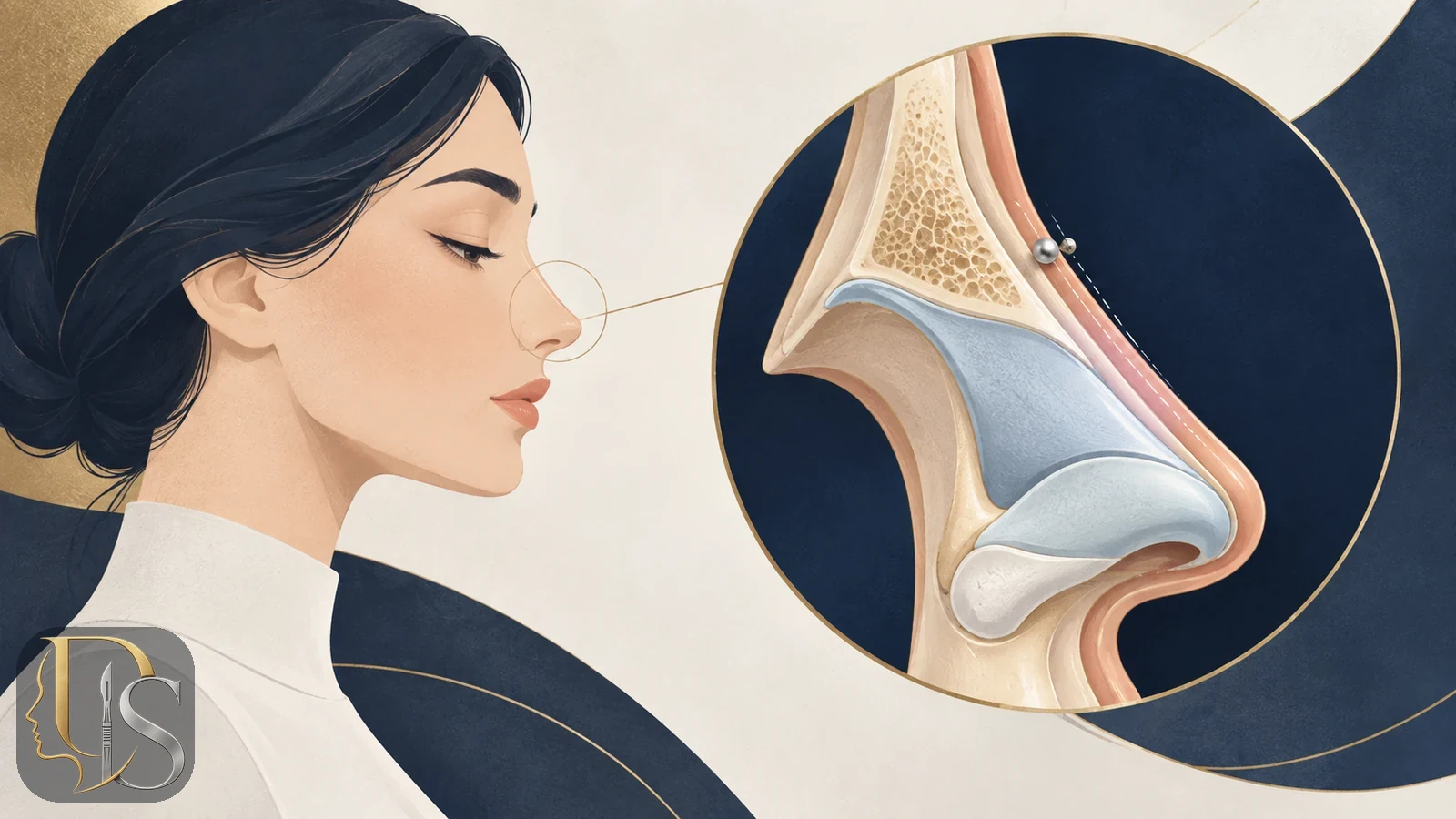
Even the best feminine design may not be achievable on a nose with thick skin or weak cartilage in the way it looks on paper. Thick skin does not shrink onto a refined tip, and weak cartilage without support cannot hold a delicate form, so the desired style has to be matched to your actual nose.
A review of thick skin in rhinoplasty describes a less elastic skin envelope, with prolonged swelling and more dead space that can change the final result (PubMed — Management of Thick Skin in Rhinoplasty). In the opposite case, thin-skinned bony noses show any irregularity of bone or cartilage under the skin, so refinement must be very precise. Both situations have their own articles.
How Should You Discuss a Feminine Nose at the Consultation?
Instead of the word "feminine", describe features: a straight or slightly concave bridge, the degree of tip rotation, how much smaller the nose should become. Bring reference photos and ask which features are achievable on your nose, and honestly ask what is not.
- Ask what "natural result" means: that people cannot tell, or only that it looks more refined?
- Treat reference photos as direction, not a final blueprint; no nose becomes a copy of another.
- Ask about breathing: how it is now and how surgery may affect it.
- Ask when the result is final: the final shape appears as swelling settles, usually over months.
A review on preoperative evaluation notes that a good consultation covers nasal history, the patient's concerns, nasal analysis, suitability for surgery and functional and psychosocial considerations (PubMed — Preoperative Evaluation of the Rhinoplasty Patient). Current costs are on the services and costs list.
Frequently Asked Questions
What makes a nose look feminine?
Three things together: a bridge with a soft line, a refined tip with gentle rotation and a size in proportion to the face. None is enough alone; their relationship with face shape and ethnic features is what makes a nose look both feminine and natural.
Does a feminine nose have to be small?
No. The smallest possible nose is not necessarily the most feminine, and a very tiny nose on a larger face looks out of scale. The right size is judged against eye distance, cheeks and chin and may be a little larger than you imagine.
Is a doll nose the same as a feminine nose?
No. A doll nose is the greatest degree of change on a spectrum, not the definition of femininity. Many natural, refined feminine noses are not doll noses, and a doll nose is not achievable on every nose.
How much should the tip be rotated?
There is no fixed figure; it depends on face shape, nose length and upper lip. Gentle rotation usually looks more natural, while too much exposes the nostrils from the front. The exact amount is set at an in-person assessment of your profile.
Does the feminine nose differ with ethnic features?
Yes. Reviews stress that the goal should be a result congruent with ethnic and gender features. A feminine nose that is natural on one structure can look foreign and artificial on another.
When Should You See a Doctor?
If you are unsure about your nose shape, or want to know which "feminine" features are achievable on your nose, an in-person examination is needed; neither reference photos nor this article can replace it. Details of the techniques are on the rhinoplasty page, and example results are in the portfolio gallery.
Sources
This article is educational and does not replace an in-person examination or consultation. Discuss any surgical decision with your own physician.
About the author

General Surgeon
Medical Council No.: 74530 · Verify in the Medical Council register
Specialist in general surgery focused on rhinoplasty, body contouring, abdominoplasty, VASER liposuction and aesthetic breast surgery.
- Specialist in general surgery
- Member of the Iranian Medical Council
- Specialist in body contouring, VASER liposuction and aesthetic breast surgery
Medically reviewed by a physician
See the full profileQuestions about this procedure?
A consultation covers your own anatomy, what is realistically achievable, and what it involves.
Rhinoplasty (Nose Surgery)Comments
No comments yet. Be the first to write one.
Related articles
Best Nose Shape for Heart and Diamond Faces
On heart faces (wide forehead, narrow chin) and diamond faces (prominent cheekbones), the most harmonious nose usually has proportionate width, a soft bridge and a refined but not tiny tip. This is a guideline, not a formula; your skin and cartilage decide.
Read moreRhinoplasty Cost in Tehran: Why Quotes Differ So Much
Rhinoplasty has no single price, because two quotes often count different things: one is the surgeon's fee alone, another includes hospital and anesthesia. The type of nose, revision surgery and airway work move the figure too.
Read moreDoll (Button) Nose Rhinoplasty: Who It Suits and Its Limits
A doll nose is small, with a narrow curved bridge and an upturned tip. It is most achievable on a bony nose with thin skin and firm cartilage, limited on a fleshy one, and over-reduction can harm breathing and is difficult to revise.
Read more