Natural or Fantasy Nose? How to Decide

In short
Choose between a natural, semi-fancy and fantasy nose with five questions: what your nose can take, whether it suits your face, whether breathing is protected, whether you will like it in ten years, and whether the decision is yours. If torn, the conservative option is usually safer.
Natural or Fantasy Nose: How Should You Decide?
The choice between a natural and a fantasy nose should not rest on taste alone; five questions clarify it: what can my nose take, does it suit my face, does it protect breathing, will I still like it in ten years, and is the decision really mine. If you are torn, the option with less change is usually safer, because rhinoplasty is generally not reversible. This article is educational and does not replace an in-person consultation.
Most articles on the "fantasy nose" describe what the style looks like. This one comes a step earlier: how to work out which point on the spectrum you are actually close to. To understand the styles themselves see the guide to nose shapes and the doll nose article; here we deal with the criteria for deciding.
What Exactly Separates Natural, Semi-Fancy and Fantasy?

These are not three separate operations but degrees on one spectrum: natural changes the nasal shape least, semi-fancy a moderate amount and fantasy the most. The names are not standardised, and every surgeon or clinic may draw the boundaries differently, so at a consultation it is better to describe features.
| Feature | Natural | Semi-fancy | Fantasy |
|---|---|---|---|
| Amount of change | Small | Moderate | Large |
| Bridge line | Straight or slightly curved | Slightly concave | Curved and narrow |
| Tip | Refined, gentle rotation | Smaller, more rotation | Very small and lifted |
| Fit with thick skin | Greater | Limited | Usually difficult |
| Chance of an artificial look | Low | Moderate | Higher |
Note that "most feminine" or "most beautiful" is not in this table; each column answers a different need. The idea of a feminine nose is covered separately in our article on the best feminine nose shape.
Question One: What Can My Nose Take?
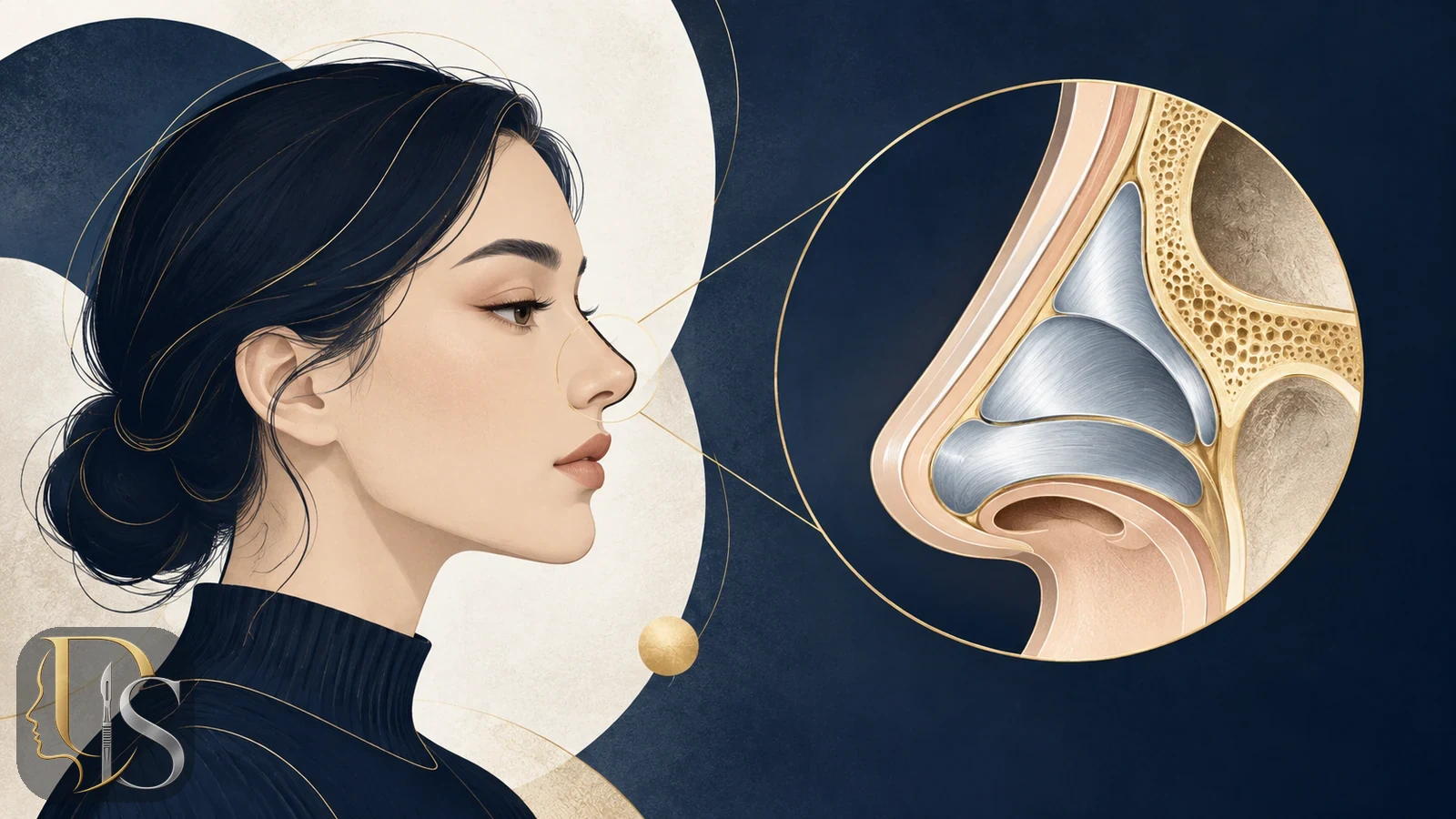
What decides whether a style is achievable is skin thickness and cartilage strength, not a reference photo. Thin skin and firm cartilage bring a nose closer to smaller, more refined styles; thick skin and weak cartilage set limits on reduction and usually sit more comfortably with a natural or mild semi-fancy result.
Skin
A review on thick skin says the skin envelope in these patients is less elastic and tends towards prolonged swelling, more dead space and scar tissue under the skin, all of which change the final shape (PubMed — Management of Thick Skin in Rhinoplasty). So a very refined tip on thick skin does not always come out as it looks in the plan.
Cartilage and bone
Weak cartilage without structural support will not hold a small tip. Before choosing a style, you need to know what structure your nose starts with. More on this is in the article on fleshy noses and the article on bony noses.
Question Two: Does It Suit My Face Shape?

A nose is always seen relative to the face; the same refined tip fits one face and looks small and unbalanced on another. A fantasy style usually sits better on round and oval faces and may look out of balance next to a wide jaw or a very narrow chin, but this is a general rule that must be confirmed at examination.
For different face shapes see: round face, long and thin face, square face and wide jaw and heart and diamond faces. A review of the "10-7-5" method also stresses analysing the nose in frontal, profile and basal views while preserving gender and ethnic congruency (PubMed — Evidence-based Nasal Analysis for Rhinoplasty: The 10-7-5 Method).
Question Three: What Happens to My Breathing?

The nose is not only a shape, it is an airway, and the more the change, the more structure is needed to protect breathing. Reducing a nose heavily or lifting the tip a lot can narrow the nasal valve. That risk is higher with a fantasy style than a natural one, but with good planning it is manageable, not removable.
A review on preoperative evaluation says a rhinoplasty consultation must weigh functional, aesthetic and psychosocial considerations together (PubMed — Preoperative Evaluation of the Rhinoplasty Patient). So if you already feel blockage or have a deviation, say so at the consultation; the chosen style can interact with it or make correcting it more important.
Question Four: Will It Still Suit Me in Ten Years?

A nose operation should be chosen for yourself ten years from now, not for today's trend. Removing cartilage and bone is generally not reversible; soft tissue loosens with age and the tip changes; and revising a heavily reduced nose is harder than refining a slightly larger one. That is why the more conservative style is usually the better insurance.
- Fashion changes: a style that is current today may look dated in a few years.
- Tissue changes: the tip usually settles slightly lower over time, and the result is not accurate before swelling subsides.
- Revision is harder: a second rhinoplasty, whether to enlarge or to fix breathing, is more difficult and complex than the first.
Question Five: Is This Decision Really Mine?

Many fantasy choices come from social media photos, and filters and angles show noses differently from reality. The honest question is: if nobody saw photos and there were no trend, would I still want this nose? If the answer is hesitation, waiting or a second consultation costs nothing.
In a validation study of 116 patients having aesthetic rhinoplasty, those who screened positive on a body dysmorphic disorder (BDD) questionnaire were less satisfied 12 months after surgery (PubMed — Body Dysmorphic Disorder in aesthetic rhinoplasty). This is not about labelling patients; it means that if thoughts about your nose constantly occupy you or disrupt daily life, telling your surgeon, and where appropriate speaking to a mental health professional, is part of making the right decision, not a barrier to it.
What Does a "Natural Nose" Really Mean?
A natural nose does not mean an untouched nose; it means a result that others do not recognise as operated and that stays in harmony with the identity of your face. There is no exact boundary and each person understands it differently, so ask your surgeon at the consultation how they define it.
- Keeping the face's identity: after surgery the nose should still belong to your face, not to a generic template.
- Gradual change: often a few small changes, such as softening a hump or refining the tip, stay more natural than one large change.
- Ethnic congruency: reviews on Middle Eastern rhinoplasty stress a result congruent with ethnic structure (PubMed — Rhinoplasty in Middle Eastern Patients).
Natural is not a synonym for "less"; sometimes one precise small change balances the face better than a large one. The goal is an "unnoticeable" nose that improves the face without drawing attention to itself.
What Increases in Surgery as You Move Towards Fantasy?
The further you go towards fantasy, the more tissue is removed and rebuilt: more reduction of cartilage and bone, more grafts and supporting sutures to hold the shape, and a longer swelling period. That is why risks and limits rise along with the degree of change.
- More removal: the smaller the nose, the smaller the margin for error, and over-reduction cannot be undone.
- More support: to protect breathing and tip shape, grafts or structural sutures are often needed and the surgery becomes more complex.
- More swelling: a heavily changed nose and thicker skin usually swell for longer, and seeing the final result takes time.
This does not mean "fantasy is forbidden"; it means that the more change, the more precision is needed and the less room for error. Details of the operation and the limits of the doll style are in the doll nose article.
Three Hypothetical Situations: How Does the Choice Change?
Three hypothetical examples show how the same questions lead to different answers. They are not real patients, only illustrations of the decision logic; the real decision is always made at an in-person examination.
Example one: thick skin and a broad tip
A person with thick skin, a broad tip and a round face brings a photo of a very small, lifted nose. Skin will not shrink onto a very refined tip and swells longer, so a mild semi-fancy or refined natural style is usually more achievable and more durable. The surgeon should say plainly that the photo's style will not sit on this nose.
Example two: thin skin and a bony hump
A person with thin skin, firm cartilage and a clear hump who wants a refined nose. Their nose suits more refined styles, but thin skin shows every irregularity, so care in shaving and softening the bridge line matters more than "smallness". Details are in the article on bony noses.
Example three: doubt and social media photos
A person who has suddenly decided and treats only filtered photos as the reference. The best step for them is not surgery; it is waiting, a second consultation and a conversation about motivation. If after a few months they still want the same result, the decision is steadier and better informed.
A Decision Table: Which Situation Is Closer to Which Style?

The table below is a general guide, not a verdict; every nose is a mix of features and examination decides. Wherever you fit more than one row, choose the more conservative style as a rule.
| Your situation | Closer style |
|---|---|
| Thick skin or weak cartilage | Natural or mild semi-fancy |
| Thin skin, firm cartilage, round or oval face | Semi-fancy, or in some cases fantasy |
| Small or recessed chin | Cautious; assess chin balance first |
| Wide jaw | Usually natural or mild semi-fancy |
| Current breathing problem | Function first, then form |
| Doubt or outside pressure | Wait or get a second opinion |
If You Are Torn, What Is the Safer Route?
If you are torn between two styles, the one with less change is usually the better choice: adding refinement later is more feasible than restoring what was removed. And instead of rushing, a second consultation or a few months of waiting costs nothing, while a hasty decision may.
- Copy reference photos less: treat them as direction, not a template.
- Ask about the limit: where does the surgeon say "this far and no further"?
- Do not treat computer imaging as final: a simulation is possible, not a commitment to a result.
- Give yourself time: leave a gap between consultation and operation.
What Should You Ask at the Consultation?
A good consultation is not only about appearance; it speaks honestly about limits. Take these questions with you to be sure every dimension has been considered. Technique details are on the rhinoplasty page and current costs on the services page.
- What will my nose not accept? An answer of "everything is possible" is not a sign of careful assessment.
- What happens to the plan if my skin is thicker than expected?
- How will my breathing change after surgery?
- If I regret it in ten years, what options exist?
- When will the final result be clear?
Frequently Asked Questions
Is a natural or a fantasy nose better?
Neither is better in absolute terms; it depends on your skin, cartilage, face shape and breathing. A natural nose usually suits most structures, while a fantasy one stays achievable and harmonious only on suitable noses, with thin skin and firm cartilage.
Can a fantasy nose be reversed after surgery?
Usually not completely. Removed cartilage and bone cannot be undone; enlarging a nose with cartilage grafts is possible but harder and more complex than the first operation. That is why a conservative choice in the first operation matters.
What is the difference between semi-fancy and fantasy?
Semi-fancy involves a moderate change and fantasy a large one; in fantasy the bridge is narrower and more curved and the tip smaller and higher. There is no sharp boundary, so at a consultation describe features rather than names.
Does thick skin rule out a fantasy nose?
It usually imposes limits rather than an absolute ban. Thick skin does not shrink onto a very refined tip and swells for longer, so milder styles tend to be more harmonious. Only an in-person examination can say what is achievable.
How much should I trust social media photos?
Not much. Filters, angles and lighting change how a nose looks, and another person's nose does not share your skin and cartilage. Use a photo as direction only and discuss with your surgeon whether it is achievable on your nose.
What should I do if I am unsure before surgery?
Wait or get a second opinion. Doubt is not a weakness; it is information about the decision. If you remain between two styles, the one with less change is usually safer, because adding later is more feasible than restoring what was removed.
When Should You See a Doctor?
If you are torn between a natural and a fantasy nose, or do not know what your nose can accept, an in-person examination is needed; an article cannot assess your skin and cartilage. You can also see example results in the portfolio gallery.
Sources
This article is educational and does not replace an in-person examination or consultation. Discuss any surgical decision with your own physician.
About the author
General Surgeon
Medical Council No.: 74530 · Verify in the Medical Council register
Specialist in general surgery focused on rhinoplasty, body contouring, abdominoplasty, VASER liposuction and aesthetic breast surgery.
- Specialist in general surgery
- Member of the Iranian Medical Council
- Specialist in body contouring, VASER liposuction and aesthetic breast surgery
Medically reviewed by a physician
See the full profileQuestions about this procedure?
A consultation covers your own anatomy, what is realistically achievable, and what it involves.
Rhinoplasty (Nose Surgery)Comments
No comments yet. Be the first to write one.
Related articles
Best Feminine Nose Shape: What Makes a Nose Look Feminine?
A feminine nose usually has a soft bridge, a refined tip with gentle rotation and a size in proportion to the face; it is not simply the smallest nose. "Feminine" is a proportion, not a template, and must suit your face shape, ethnic features, skin and cartilage.
Read moreBest Nose Shape for Heart and Diamond Faces
On heart faces (wide forehead, narrow chin) and diamond faces (prominent cheekbones), the most harmonious nose usually has proportionate width, a soft bridge and a refined but not tiny tip. This is a guideline, not a formula; your skin and cartilage decide.
Read moreRhinoplasty Cost in Tehran: Why Quotes Differ So Much
Rhinoplasty has no single price, because two quotes often count different things: one is the surgeon's fee alone, another includes hospital and anesthesia. The type of nose, revision surgery and airway work move the figure too.
Read more