Best Nose Shape for Heart and Diamond Faces

In short
On heart faces (wide forehead, narrow chin) and diamond faces (prominent cheekbones), the most harmonious nose usually has proportionate width, a soft bridge and a refined but not tiny tip. This is a guideline, not a formula; your skin and cartilage decide.
What Is the Best Nose Shape for Heart and Diamond Faces?
A nose whose width is in proportion to the distance between the eyes, with a soft bridge and a refined but not tiny tip, tends to look more harmonious on both face shapes than a very large or very small nose. Both faces have a narrow lower third, and a heavy or an extremely small nose upsets that balance. This article is educational and does not replace an in-person examination.
Heart and diamond faces look similar at first glance because both have a narrow chin, but their widest point differs, and that changes what the nose should do. Below: how to tell the two apart, why face shape affects nose choice, what each shape asks of the bridge and tip, how natural and fantasy styles fit, and what a nose cannot fix.
How Do You Tell a Heart Face From a Diamond Face?

On a heart face the widest part is the forehead, and the face narrows towards a slim, sometimes pointed chin. On a diamond face the widest part is the cheekbones, and both forehead and jaw are narrower than that. The real difference is not the chin but where the upper width comes from: forehead or cheek.
| Feature | Heart face | Diamond face |
|---|---|---|
| Widest part | Forehead | Cheekbones |
| Forehead | Wide | Narrow to medium |
| Cheeks | Medium | Prominent and wide |
| Jawline | Gradually tapering | Narrow |
| Chin | Slim, sometimes pointed | Narrow |
A simple check at home
Take a straight-on photo with your hair pulled back and compare three widths: forehead, cheekbones and jaw. If the forehead is widest you lean heart; if the cheekbones are widest you lean diamond. Many faces are a blend, so this is only a rough guide, and proper measurement is done at an in-person consultation.
Why Does Face Shape Influence the Choice of Nose?

The eye never judges a nose alone; it judges its relationship to the forehead, cheeks, lips and chin, and that relationship is what makes a nose look large, small or balanced. For this reason rhinoplasty surgeons analyse the nose in frontal, lateral and basal views together with the proportions of the whole face.
A review of the "10-7-5" nasal analysis method stresses that a systematic frontal, lateral and basal analysis is the most important preoperative step and that gender and ethnic congruency should be preserved (PubMed — Evidence-based Nasal Analysis for Rhinoplasty: The 10-7-5 Method). That analysis measures proportion. A fixed, evidence-based "nose for a heart face" or "nose for a diamond face" does not exist; what you read in educational articles is aesthetic convention and clinical experience. Treat it as guidance, not a rule.
What Suits a Heart Face?

On a heart face a harmonious nose usually has a soft bridge without sharp angles, a refined tip that still reads as complete, and a width in proportion to the eye distance. The aim is to avoid a tiny nose that makes the already narrow lower face look weightless, and also a heavy nose that makes the upper face look heavier.
Bridge and root
A straight or gently softened bridge generally stays in harmony with a wide forehead. A very low root can make the top of the nose wide and the face top-heavy; a very high one can compete with the forehead. The right level is judged on the full profile.
The tip
A refined, slightly rotated tip keeps the narrow lower face from looking light. An extremely small, sharp tip next to a narrow chin can make the face look more pointed, so an overly small, lifted tip is usually a cautious choice here. Balancing delicacy against presence is the key decision for this face shape.
What Suits a Diamond Face?

On a diamond face the prominent cheekbones are the widest part, so a harmonious nose usually does not add to midface width: a bridge neither very narrow nor wide, a tip of moderate presence and well-proportioned nostrils. The goal is to stop the already wide midface from becoming more unbalanced.
- A very narrow bridge next to prominent cheeks creates a contrast of scale and can make the midface look wider.
- A wide bridge and nostrils repeat the midface width and flatten the cheekbones.
- A tip of moderate presence balances the narrow chin without looking faint or heavy.
Unlike the heart face, the forehead here is not wide, so the root matters less and the decision centres on midface width. These remain general guidelines; measurements on your own face decide.
Natural, Semi-Fancy or Fantasy: Which Fits These Faces?

For heart and diamond faces, natural and mild semi-fancy styles usually fit best; fantasy and doll styles stay harmonious only in specific conditions: a chin that is not very narrow, thin skin and firm cartilage. The caution exists because a very small nose on a narrow chin turns delicacy into imbalance.
| Style | With a heart face | With a diamond face |
|---|---|---|
| Natural | Usually harmonious | Usually harmonious |
| Mild semi-fancy | Usually harmonious | Usually harmonious |
| Fantasy / doll | Conditional; needs suitable chin and skin | Conditional; needs controlled midface width |
Each style is a point on a spectrum, not a fixed name. To understand the differences read the article on the doll nose and its limits and the guide to nose shapes. The choice among the three is covered separately in our natural-versus-fantasy decision guide.
When a Narrow or Small Chin Changes How the Nose Looks

When the chin is small or recessed, the nose looks larger in profile than it really is. On heart and diamond faces, where the chin is naturally narrow, this effect is common. In that case, reducing the nose alone may not fix the proportion and can leave the nose smaller than needed.
During a rhinoplasty assessment the nose-to-chin balance in profile is examined. Sometimes the conclusion is that part of the apparent size does not come from the nose. Dr. Salmani does not perform jaw or chin bone surgery; if the analysis shows the main issue is the chin, that is said plainly so the nose is not over-reduced for something it did not cause. This is precisely what "choose a nose by face shape" advice most often skips.
How Do Skin Thickness and Bone Structure Limit the Choice?
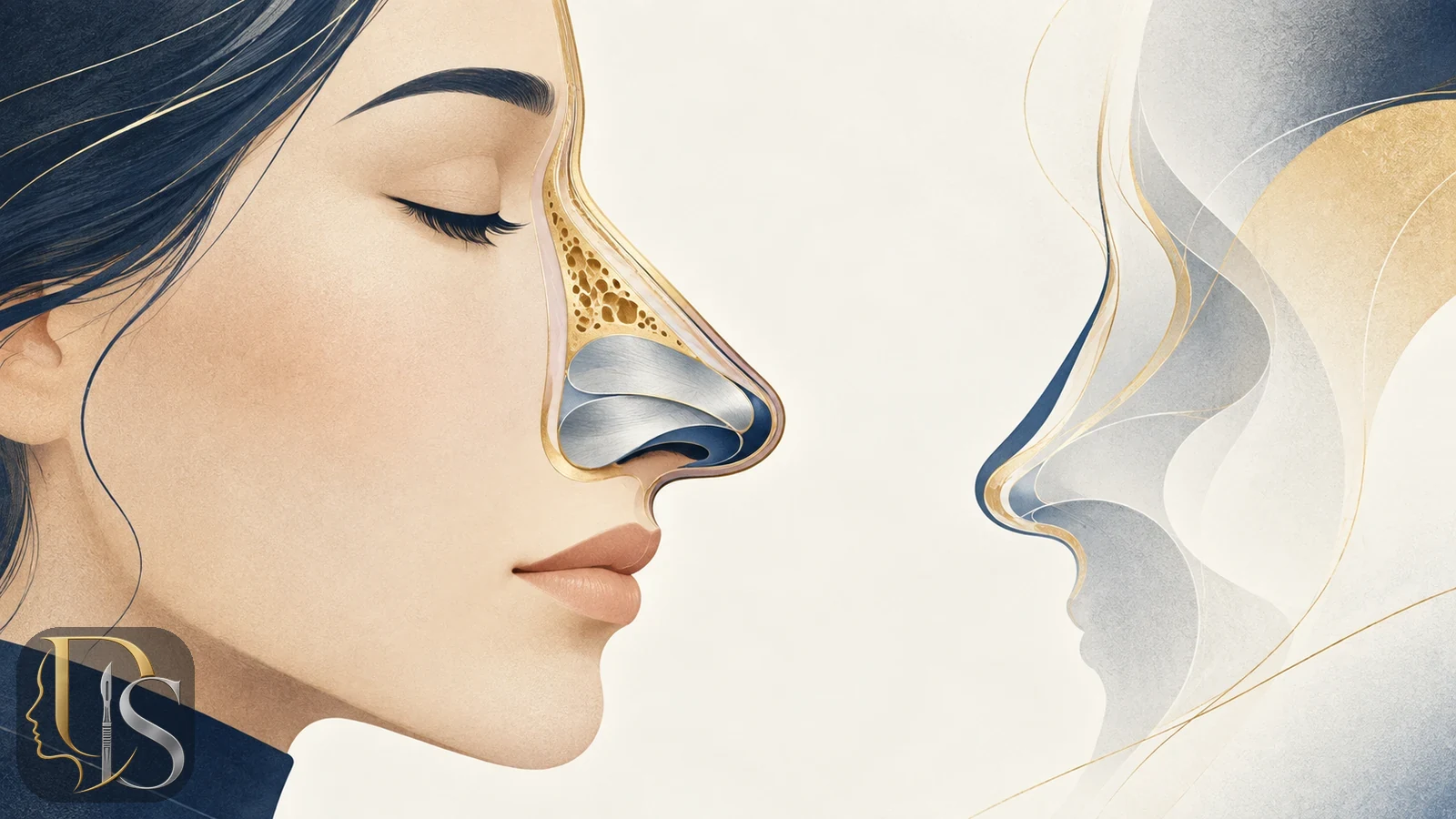
Face shape is only one factor. Skin thickness and cartilage strength decide how much of the desired style is achievable on your nose. Thick skin does not shrink onto a refined tip, and weak cartilage will not hold a small tip without support, so the style that suits your face may differ from the one your nose can deliver.
A review in Facial Plastic Surgery Clinics describes the skin-soft tissue envelope in thick-skinned patients as less elastic, with a tendency to prolonged swelling and more dead space, all of which shape the final result (PubMed — Management of Thick Skin in Rhinoplasty). So before choosing a reference photo, learn what your own nose will accept. We cover this in the article on fleshy noses and the article on bony noses.
Common Mistakes When Choosing a Nose by Face Shape

Choosing from face-shape names alone produces four recurring mistakes: treating heart and diamond as the same, copying a celebrity's nose, ignoring skin thickness, and shrinking the nose to compensate for the chin. All four come from turning a general guideline into a formula.
Treating heart and diamond as the same
Both have a narrow chin and are often grouped in general articles. But on a heart face the balance of the upper face (forehead and root) is the issue, while on a diamond face it is the midface (cheekbones and bridge width). A wrong diagnosis makes even the general advice wrong.
Copying someone else's nose
A nose that looks beautiful on one face does not stay harmonious on another. A reference photo should be a direction, because that person's chin, cheeks, skin and cartilage differ from yours.
Shrinking the nose to fit the chin
Removing cartilage and bone is generally not reversible, and revising a nose that was reduced too far is harder than refining a slightly larger one. Being conservative at the first operation is cheaper than correcting it later.
How Does the Nose Relate to the Eyes, Lips and Forehead?
The nose is judged against the eyes, upper lip and forehead, not in isolation. On a heart face the eye distance and root depth relate to the wide forehead; on a diamond face midface width comes from the cheekbones and the nose is read against that. Final nose size emerges from these relationships.
A review on preoperative evaluation notes that a good consultation covers medical and nasal history, the patient's concerns, nasal analysis and suitability for surgery, weighing functional, aesthetic and psychosocial considerations together (PubMed — Preoperative Evaluation of the Rhinoplasty Patient). Breathing is part of that: reducing the nose too much because of face shape can narrow the airway.
What Can a Nose Not Change?
Rhinoplasty changes how the nose relates to the face, not the face shape itself. It cannot alter forehead width, cheekbone prominence or jaw angle; it can only be shaped so those features look better balanced. Expecting to turn a heart face into an oval one through the nose is unrealistic.
- Forehead and cheeks: unchanged by rhinoplasty; only the nose's relation to them changes.
- Chin: if small or recessed it makes the nose look bigger, and the nose cannot take its place.
- Skin and cartilage: they set the range of change, not a reference photo or personal taste.
Honesty means knowing before surgery what is achievable and what is not. The final result becomes clear as swelling subsides, usually over the following months, and varies between people.
How Should You Talk About Face Shape at the Consultation?
Instead of style names such as "fantasy" or "doll", describe features: a straight or soft bridge, how much the tip is rotated, how much shorter you want the nose. Bring photos of noses you like, ideally on faces similar to yours, and ask which features are achievable on your nose.
- Bring front and profile photos with your hair back and no filters.
- Treat reference photos as direction, not a final blueprint; no nose ever becomes a copy of another.
- Ask what is not achievable. A surgeon's honest answer is not only "yes".
- Ask about swelling and when the result is final. The final shape appears as swelling settles and is not accurate in the first weeks.
You can also look at the current list of services and costs before the consultation; no price figure appears in this article on purpose, so it does not go out of date.
Frequently Asked Questions
What is the best nose shape for a heart face?
A nose with a soft bridge, a refined but not tiny tip and a width in proportion to the eye distance. Because the chin is narrow, a very small, sharp tip makes the face look more pointed, so balancing delicacy and presence is the key point.
What is the best nose shape for a diamond face?
A nose that does not add to midface width: a bridge neither very narrow nor wide, a tip of moderate presence and proportionate nostrils. The cheekbones are the widest part, and a very narrow or wide nose upsets that balance.
Is a fantasy nose suitable for a heart face?
Sometimes, not for everyone. A very small nose on a narrow chin can lose balance. A fantasy style stays harmonious only when the chin is not very narrow and thin skin with firm cartilage makes it achievable; an examination settles this.
How does a heart face differ from a diamond face when choosing a nose?
On a heart face the widest part is the forehead, so the root and bridge are judged against it; on a diamond face the widest part is the cheekbones, so attention goes to midface width, meaning bridge and nostrils. A narrow chin affects the tip in both.
Can photos alone show which nose suits my face?
Not fully. A photo is a flat view, often with angle or filter effects. Real nasal analysis is done in three views on the actual face and includes skin thickness and cartilage strength, which are seen only at an in-person examination.
When Should You See a Doctor?
If you are unsure how your nose relates to your face shape, or you feel the nose is too large or small against your chin and cheeks, an in-person assessment is needed; face shape cannot be judged from photos or general rules alone. Details of the techniques are on the rhinoplasty page, and example results are in the portfolio gallery.
Sources
This article is educational and does not replace an in-person examination or consultation. Discuss any surgical decision with your own physician.
About the author

General Surgeon
Medical Council No.: 74530 · Verify in the Medical Council register
Specialist in general surgery focused on rhinoplasty, body contouring, abdominoplasty, VASER liposuction and aesthetic breast surgery.
- Specialist in general surgery
- Member of the Iranian Medical Council
- Specialist in body contouring, VASER liposuction and aesthetic breast surgery
Medically reviewed by a physician
See the full profileQuestions about this procedure?
A consultation covers your own anatomy, what is realistically achievable, and what it involves.
Rhinoplasty (Nose Surgery)Comments
No comments yet. Be the first to write one.
Related articles
Rhinoplasty Cost in Tehran: Why Quotes Differ So Much
Rhinoplasty has no single price, because two quotes often count different things: one is the surgeon's fee alone, another includes hospital and anesthesia. The type of nose, revision surgery and airway work move the figure too.
Read moreDoll (Button) Nose Rhinoplasty: Who It Suits and Its Limits
A doll nose is small, with a narrow curved bridge and an upturned tip. It is most achievable on a bony nose with thin skin and firm cartilage, limited on a fleshy one, and over-reduction can harm breathing and is difficult to revise.
Read moreAquiline Nose Rhinoplasty: The Hump and the Drooping Tip
An aquiline nose combines a prominent hump with a tip that curves downward. Correcting it is not just hump removal: the tip has to be rotated up and given cartilage support, or it looks more drooped once the hump is gone.
Read more