Doll (Button) Nose Rhinoplasty: Who It Suits and Its Limits

In short
A doll nose is small, with a narrow curved bridge and an upturned tip. It is most achievable on a bony nose with thin skin and firm cartilage, limited on a fleshy one, and over-reduction can harm breathing and is difficult to revise.
What Does a Doll Nose Look Like?
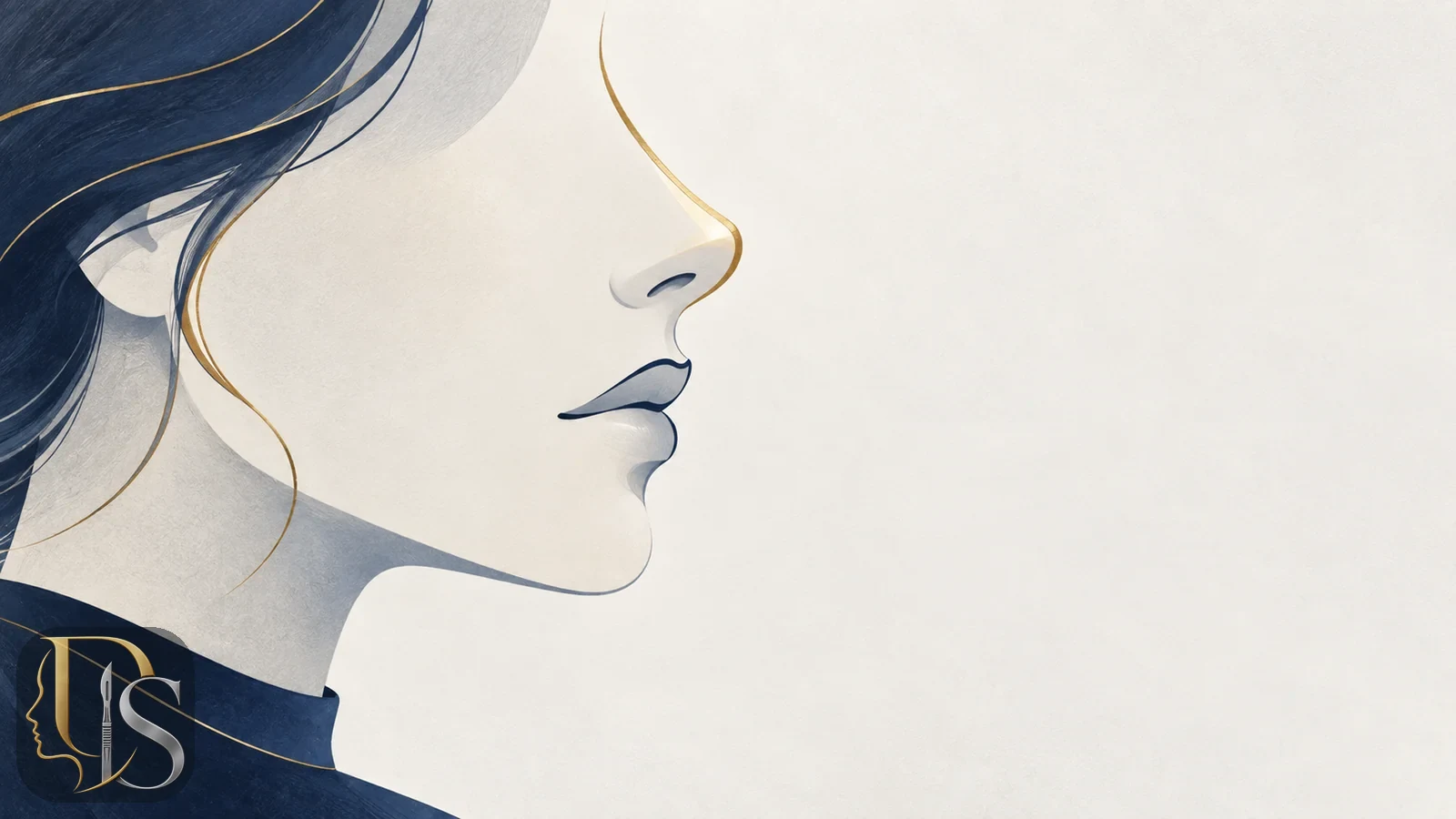
A doll or button nose is small and short, with a narrow bridge that curves slightly inward in profile and a tip rotated upward. It has two origins: some people are born with it, and for many others it is the result of rhinoplasty with the greatest degree of change. This article is about the second: who can get there, and what is given up in exchange. It is educational and does not replace an in-person examination and consultation.
- A narrow, curved bridge: in profile the line dips inward rather than running straight.
- A small, upturned tip: the angle between tip and upper lip is wider than usual.
- A shorter nose: less distance from root to tip.
- More space between lip and tip: the upper lip looks longer.
Where this shape sits among the other five is set out in the guide to nose shapes.
Doll, Fancy and Semi-Fancy: What Is the Difference?

These are points on one scale, not separate operations. In the terms commonly used in Iran, "natural" involves the least change, "semi-fancy" a moderate amount and "fancy" the most; "doll" is the far end of fancy — the smallest nose, the deepest curve, the most upturned tip. Some people use the last two interchangeably.
| Model | Bridge | Tip | Degree of change |
|---|---|---|---|
| Natural | Straight, close to natural height | Little rotation | Small |
| Semi-fancy | Slightly narrower, gentle curve | Moderate rotation | Moderate |
| Fancy | Narrow and curved | Small and upturned | Large |
| Doll | Very narrow, obvious curve | Very small and upturned | Greatest |
These are everyday labels, not a medical classification, and two surgeons may mean different things by "semi-fancy". At consultation, talk about three concrete things instead of a label: the line of the bridge, how far the tip is rotated, and the final size of the nose.
Which Faces Does a Doll Nose Suit?

A doll nose sits best on a small face with delicate features and a chin that is not especially strong. On a large face, a wide jaw, or a long, thin face, a very small nose creates a mismatch in scale and makes the other features look larger.
- Small, oval face: the best match, provided skin and cartilage allow it.
- Round face: a much smaller nose makes the width of the face stand out; see nose shape for a round face.
- Long, thin face: a tiny nose against prominent bone structure makes the face look thinner; see nose shape for a long, thin face.
- Square face, wide jaw: a mismatch with the jaw; see nose shape for a square face.
Height and sex matter too
The StatPearls review of rhinoplasty describes greater tip rotation as, up to a point, a youthful and feminine feature, and as more acceptable in shorter women. It describes a tip closer to a right angle as more masculine — which is why a doll nose almost always looks artificial on a male face.
Which Noses Can Become a Doll Nose?

Whether a doll nose is achievable is decided by the tissue, not by the patient's wishes. Thin skin and firm cartilage are the two conditions: thin skin shrinks down over a reduced framework and shows refinement, and firm cartilage can hold a lifted tip for years.
| Starting nose | Feasibility | Why |
|---|---|---|
| Bony, thin skin, firm cartilage | Highest | Skin redrapes over a smaller framework |
| Semi-fleshy | Limited; usually to semi-fancy | Skin shrinks less |
| Fleshy, thick skin | Very limited | Thick skin hides refinement; soft cartilage will not hold the tip |
| Large nose with a big hump | Limited | Heavy resection endangers support |
| Previously operated nose | Depends on what remains | Scar tissue and a shortage of cartilage |
Why thick skin is the limit
The skin of the lower third is the thickest on the nose. When the framework beneath thick skin is made very small, the skin does not shrink to match and the gap fills with scar tissue; the result is a round, shapeless tip rather than a refined one. On a fleshy nose the realistic goal is usually a natural or gently semi-fancy result.
How Is It Done?
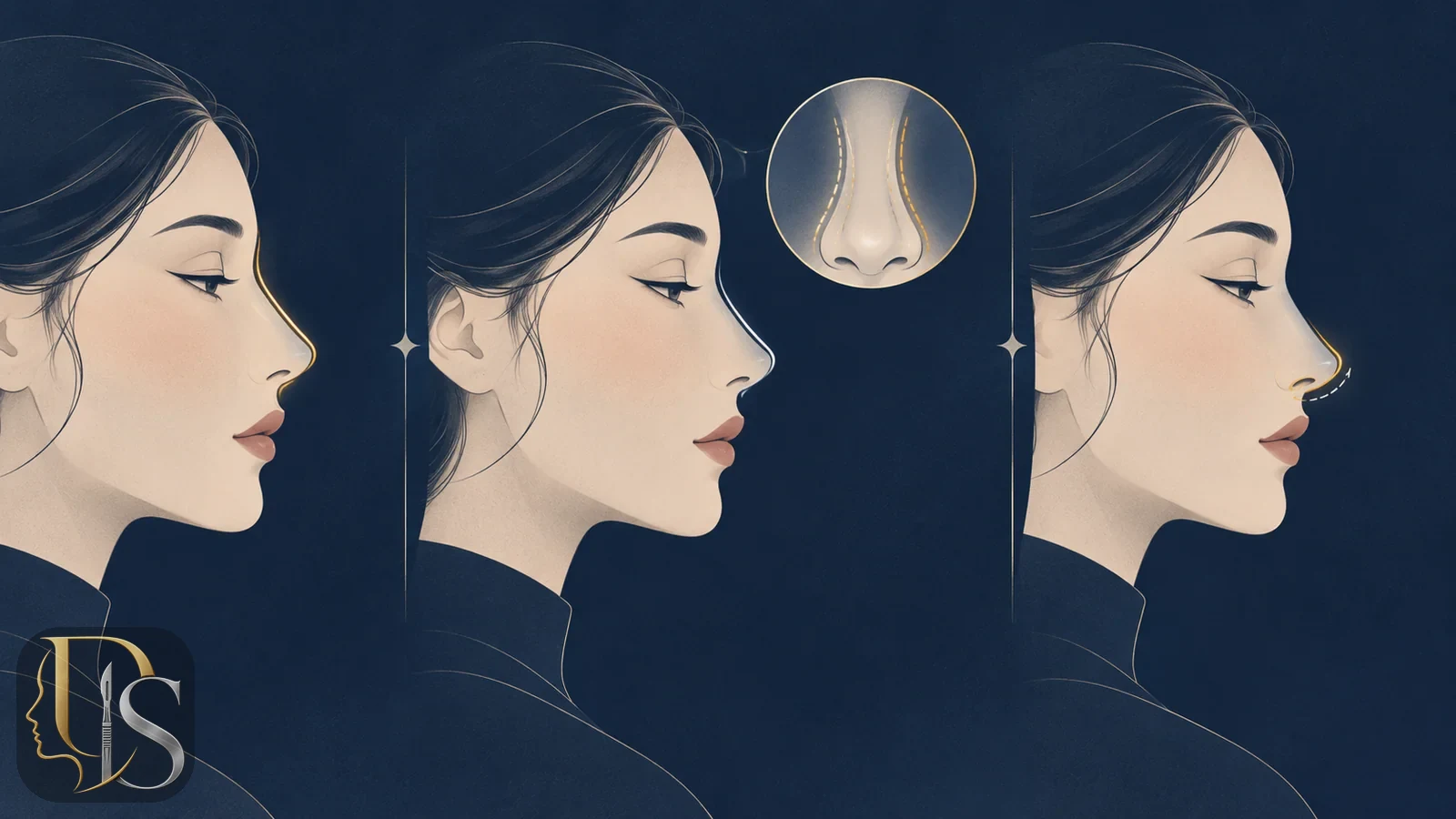
There is no separate "doll nose operation". It is rhinoplasty with a larger degree of change in three areas: the bridge, the side walls and the tip. With Dr. Salmani Moghaddam, rhinoplasty is performed under general anesthesia and usually takes 2 to 3 hours.
- Bridge: the hump is removed and the line set slightly below straight, to create the curve.
- Side walls: controlled bone cuts bring them together so the bridge looks narrow from the front.
- Tip: part of the edge of the tip cartilages is trimmed and the tip shaped with sutures.
- Rotation: the tip is turned upward and secured with a cartilage graft.
- Nostrils: if they still look wide once the tip is smaller, their base is sometimes narrowed slightly.
Every reduction needs support
The StatPearls chapter on tip-shaping surgery stresses that adequate tip support must be rebuilt at the end of the operation, and that many later problems, aesthetic and functional, trace back to excessive manipulation that disrupted it. In modern rhinoplasty cartilage is not only removed; it is repositioned and reinforced. More detail is on the rhinoplasty page.
What Are the Trade-Offs?

A doll nose carries three possible consequences that should be understood before deciding: harder breathing, an artificial look, and difficulty revising it. The more the nose is reduced, the more likely each becomes.
Breathing
A nose is an airway as well as a shape. Narrowing the bridge narrows the internal nasal valve, the tightest point of that airway. The tip-shaping chapter also notes that the nostril rims contain no cartilage, only soft tissue; removing too much tip cartilage can weaken the nostril so that it collapses inward on a deep breath.
An artificial look
The same source calls an over-rotated nose a telltale sign of poor rhinoplasty and gives the acceptable tip-to-lip angle in women as about 95 to 115 degrees. Beyond that range the nostrils show from the front and the nose looks operated on.
Change over time, and difficult revision
StatPearls notes that the nose keeps changing shape over the years after surgery and that predicting its appearance two decades on is difficult. A nose from which a great deal has been removed has no reserve for those changes. And if revision is ever needed, the same source describes revision as the most complicated kind of rhinoplasty, because of scar tissue and a shortage of cartilage for grafting.
What Is a "Natural" Doll Nose?
A natural doll nose is the conservative version of the same idea: a gentle curve, a tip within the accepted range, and a size still in proportion to the face. In practice it is what many people call semi-fancy. It differs from the extreme version in three decisions.
- Bridge: a gentle curve rather than a deep scoop, with a very slight prominence left in the framework.
- Tip: rotation within the natural range, held by a supporting graft rather than by heavy cartilage removal.
- Size: reduced only as far as the skin can redrape and breathing is not compromised.
If what you want is "more refined and slightly upturned" rather than "the smallest nose possible", this version usually lasts better and carries less risk.
Recovery and When the Result Shows

Initial recovery usually takes 1 to 2 weeks, but this style needs more patience before the final shape shows, because more change means more swelling. The cast typically comes off after a week; according to the American Society of Plastic Surgeons, the nasal contour can take up to a year to fully refine.
| Period | What usually happens |
|---|---|
| First week | Cast on the nose, swelling and bruising |
| End of week one | Cast removed; tip higher and nose larger than the final result |
| Months one to three | Tip settles slightly, bridge swelling eases |
| Months three to six | The true curve of the bridge appears |
| Up to a year | Tip stabilises, later in thick skin |
If you are travelling to Tehran
Allow 7 to 10 days for the whole process: consultation, tests, surgery and the first follow-up. Because the early appearance is misleading in this style — the tip sits higher than it will end up — agree a schedule for sending photographs after you return home, and ask what would count as a reason to get in touch sooner.
Who Should Not Choose a Doll Nose?
It is not for everyone, and sometimes the honest answer is not to do it. In these situations either the result will not match the expectation, or the price outweighs the gain.
- A fleshy nose with thick skin: the result will not match the mental picture, and a shapeless tip is likely.
- A history of nasal obstruction: further narrowing makes it worse.
- A male face, or a large face with a wide jaw: a mismatch rather than balance.
- A decision based on a filter or someone else's photograph: the same shape on different bone and skin gives a different result.
- Severe distress over a very minor flaw: StatPearls lists body dysmorphic disorder among the situations in which surgery does not bring satisfaction and a behavioral health assessment is needed first.
Risks
The risks are those of rhinoplasty, with a higher likelihood in the areas that depend on how much is removed. StatPearls reports complication rates of about 3 percent and revision rates of up to 15 percent, and names poor tip appearance or function as a common reason for a second operation.
- General: bleeding, bruising and swelling, infection, reactions to anesthesia.
- From over-reduction: obstructed breathing, nostril collapse on inspiration, retracted nostril rims.
- Appearance: over-rotated tip, scooped bridge, fullness above the tip, irregularities showing through thin skin.
- Second surgery: the result is usually judged, and revision considered, no sooner than a year after the operation.
Frequently Asked Questions
Can a fleshy nose be made into a doll nose?
Rarely, and with a limited result. Thick skin does not shrink over a very small framework, and soft cartilage will not hold an upturned tip. On a fleshy nose the realistic goal is a natural or gently semi-fancy result, which also lasts better.
Does a doll nose drop after a few years?
The tip settles a little in the first months, which is normal. A noticeable drop years later tends to happen when the tip was lifted without enough support — which is why a supporting graft matters.
Is a doll nose done for men?
It is generally not advised. A scooped bridge and upturned tip are out of keeping with male facial features and look artificial. For men the usual goal is a straight bridge and a tip close to a right angle.
From what age can it be done?
Once the nasal skeleton has finished developing, which StatPearls puts at roughly 15 in girls and 17 in boys. For a style involving this much change, waiting until the decision and personal taste have settled — usually 18 or later — makes more sense.
Does a doll nose cost more?
Cost follows the complexity of the work, not the name of the style. Starting prices are on the services and pricing page, and what drives the figure is explained in why rhinoplasty quotes differ.
Can it be reversed if I regret it?
Partly, and with a more difficult operation. Tissue that has been removed does not come back, and rebuilding usually needs cartilage grafts from the septum, the ear or a rib. That is the argument for removing less in the first place.
When Should You See a Surgeon?
If you are thinking about a smaller, more refined nose, have the tissue examined before choosing a label. The consultation covers skin thickness, cartilage strength, breathing and proportion with the face, and you are told honestly how much change is achievable and durable on your nose. Real outcomes are in Dr. Salmani Moghaddam's results gallery, and you can book a consultation online.
Sources
This article is educational and does not replace an in-person examination or consultation. Discuss any surgical decision with your own physician.
About the author
General Surgeon
Medical Council No.: 74530
Board-certified general surgeon focused on rhinoplasty, body contouring, abdominoplasty, VASER liposuction and aesthetic breast surgery.
- Board-certified general surgeon
- Member of the Iranian Medical Council
- Specialist in body contouring, VASER liposuction and aesthetic breast surgery
Medically reviewed by a physician
See the full profileQuestions about this procedure?
A consultation covers your own anatomy, what is realistically achievable, and what it involves.
Rhinoplasty (Nose Surgery)Comments
No comments yet. Be the first to write one.
Related articles
Rhinoplasty Cost in Tehran: Why Quotes Differ So Much
Rhinoplasty has no single price, because two quotes often count different things: one is the surgeon's fee alone, another includes hospital and anesthesia. The type of nose, revision surgery and airway work move the figure too.
Read moreAquiline Nose Rhinoplasty: The Hump and the Drooping Tip
An aquiline nose combines a prominent hump with a tip that curves downward. Correcting it is not just hump removal: the tip has to be rotated up and given cartilage support, or it looks more drooped once the hump is gone.
Read moreRoman Nose: What It Is and How Rhinoplasty Changes It
A Roman nose has a raised bridge with a gentle, continuous curve and a tip that does not droop. Correcting it means lowering the hump by resection or dorsal preservation; a natural result avoids a scooped bridge and stays in proportion with the face.
Read more