Roman Nose: What It Is and How Rhinoplasty Changes It

In short
A Roman nose has a raised bridge with a gentle, continuous curve and a tip that does not droop. Correcting it means lowering the hump by resection or dorsal preservation; a natural result avoids a scooped bridge and stays in proportion with the face.
What Does a Roman Nose Look Like?
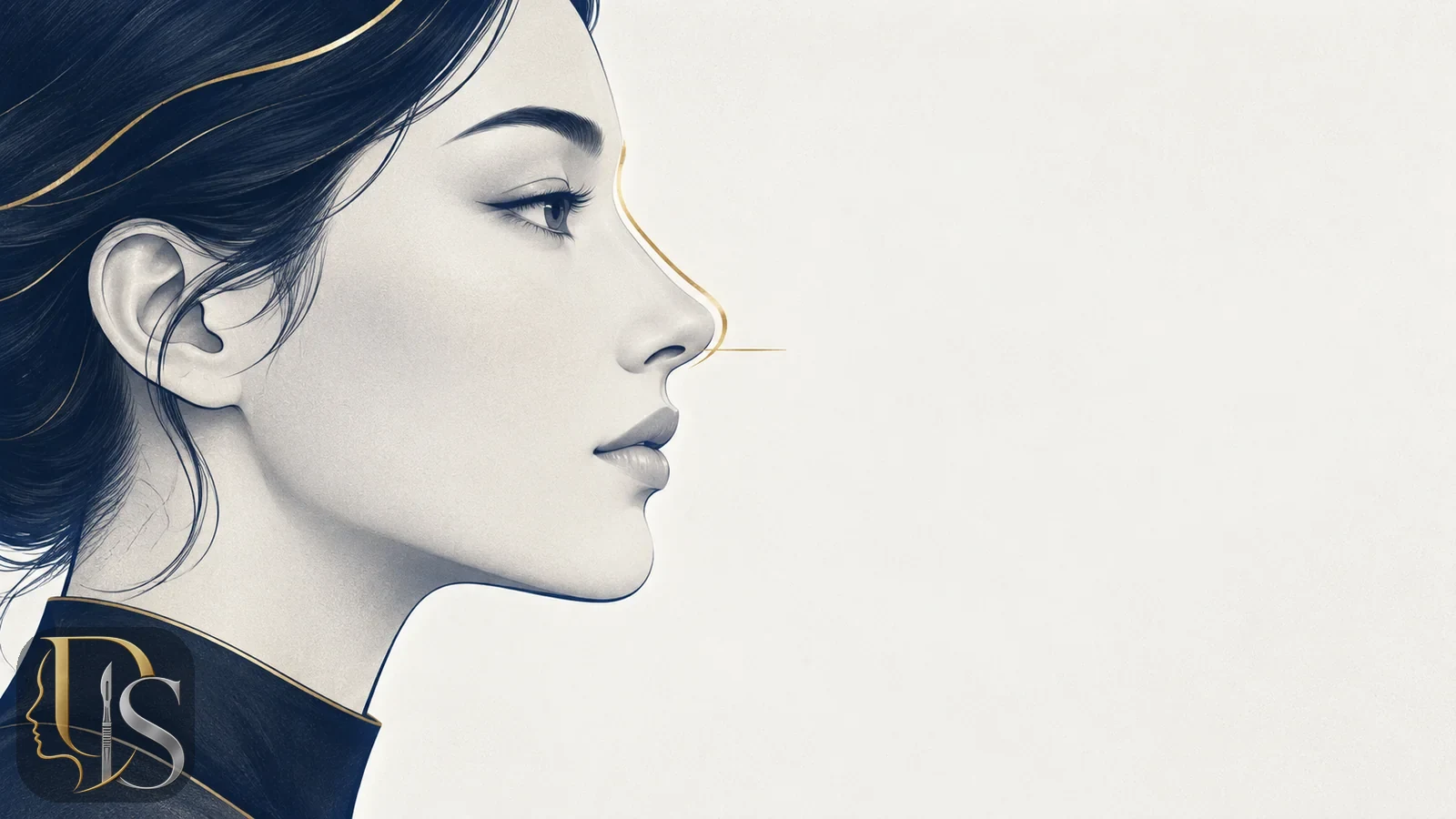
A Roman nose is one whose bridge follows a gentle outward curve rather than a straight line. The curve begins near the root of the nose and continues to just above the tip, while the tip itself is not pulled downward. The name comes from the profiles of ancient Roman sculpture, and it is a normal variant of nasal shape, not a defect. This article is educational and does not replace an in-person examination and consultation.
Signs of a Roman nose in profile and from the front
- A continuous curve: the prominence is a long, gentle arc along most of the bridge, not a single sharp point.
- A neutral tip: neither upturned nor drooping, which is what separates it from an aquiline nose.
- A deep root: the hollow between the eyes is usually well defined, which makes the curve stand out.
- From the front: the bridge often looks strong and slightly wide; the curve itself only shows in profile.
If you are not sure which shape you have, the six common shapes are compared in the guide to nose shapes.
Why Does a Nose Look "Roman"?

Whether a nose reads as Roman depends on the depth of the nasal root as much as the height of the bridge. According to the StatPearls review of rhinoplasty, a nose with a deep root and a prominent bridge is seen as having a hump (a "Roman" nose), whereas an equally prominent bridge next to a shallow root — where the nose seems to join the forehead directly — is not perceived as a hump at all (a "Greek" nose).
Bony, cartilaginous or both
A Roman hump is almost never bone alone. The same source explains that most humps sit over the junction where the nasal bones give way to cartilage, so they have two parts: bone above and cartilage below. How much of each varies from person to person, and that proportion is what decides the method of correction.
What the skin does
Nasal skin is not the same thickness everywhere: it is thinnest over that bone–cartilage junction and thickest in the lower third. In practice this means that once swelling settles, any small irregularity on the bridge shows sooner there than anywhere else on the nose.
Roman vs. Aquiline vs. Greek Nose

These three are often confused, and some sources treat Roman and aquiline as the same thing. They differ in two respects: how pronounced the curve is, and what the tip does. A Roman nose has a gentle curve and a neutral tip; an aquiline nose has a stronger curve and a tip that turns down; a Greek nose has a straight bridge and a root almost level with the forehead.
| Feature | Roman | Aquiline | Greek |
|---|---|---|---|
| Bridge line | Gentle, continuous curve | Stronger, more prominent curve | Straight |
| Tip | Neutral | Turned down | Neutral |
| Root | Deep | Deep | Shallow, level with the forehead |
| Usual correction | Lower the hump | Lower the hump and lift the tip | Usually none needed |
If your tip drops further when you smile, the nose is probably closer to aquiline; that is covered in aquiline nose rhinoplasty.
Does a Roman Nose Need Surgery?

A Roman nose is not a medical problem and does not need correcting. Surgery makes sense when the person themselves feels the curve is out of keeping with the rest of their face, or when a breathing problem such as a deviated septum is present as well. On many faces — particularly those with a strong forehead and chin — that gentle curve is part of the balance, and removing it weakens the face.
Who tends to do well
- Someone who knows exactly what they dislike: "the hump in my profile" is a clear request; "a different nose" is not.
- Someone whose face has finished growing: per StatPearls, surgery is usually performed once the nasal skeleton is fully developed, at roughly 15 in girls and 17 in boys.
- Someone with realistic expectations: the same source treats patient satisfaction as the main measure of success, and careful patient selection as its best predictor.
Roman noses in men and women
The goal differs by sex. On a male face the bridge is usually left straight, or with the faintest remnant of the curve, and the tip is not rotated upward; StatPearls describes the angle between the tip and the upper lip as roughly 90 to 95 degrees in men and 95 to 110 degrees in women. A scooped bridge and an upturned tip tend to look unnatural on a man.
How Is a Roman Nose Corrected?

Correcting a Roman nose means lowering the curve of the bridge, and there are two families of technique: removing the hump from above (resection), and dorsal preservation, in which the whole bridge is lowered from below. The choice depends on the size and make-up of the hump, skin thickness and breathing, and is made at examination. With Dr. Salmani Moghaddam, rhinoplasty is performed under general anesthesia and usually takes 2 to 3 hours.
Resection of the hump
The cartilaginous part of the hump is trimmed with a fine blade and the bony part is reduced with a rasp or a bone-cutting instrument. According to StatPearls, humps with a small bony component can be rasped, while larger ones need the bone resected.
Closing the "open roof"
When a large hump is removed, the top of the bridge is left open like a roof with the ridge taken off. The same source explains that this gap has to be closed by controlled cuts in the side walls of the nasal bones so they can be brought together; otherwise the bridge looks wide and flat from the front.
Dorsal preservation
Here the top surface of the bridge is left alone. A strip of septum beneath it is removed, and the bridge descends as one piece. The advantage is that the natural junction of the cartilages stays intact and no open roof is created; the limitation is that it depends on very precise bone cuts and does not suit every nose.
| Resection | Dorsal preservation | |
|---|---|---|
| What is removed | The prominence itself, from the top | A strip of septum beneath the bridge |
| Top surface of the bridge | Rebuilt | Left intact |
| Better suited to | Most humps, including irregular ones | Regular humps on a sound bridge |
| Key point | Closing the open roof, supporting the middle third | Precision of the bone cuts |
Operating time, anesthesia and hospital stay are set out on the rhinoplasty page.
Why Shouldn't the Bridge Be Made Completely Flat or Scooped?
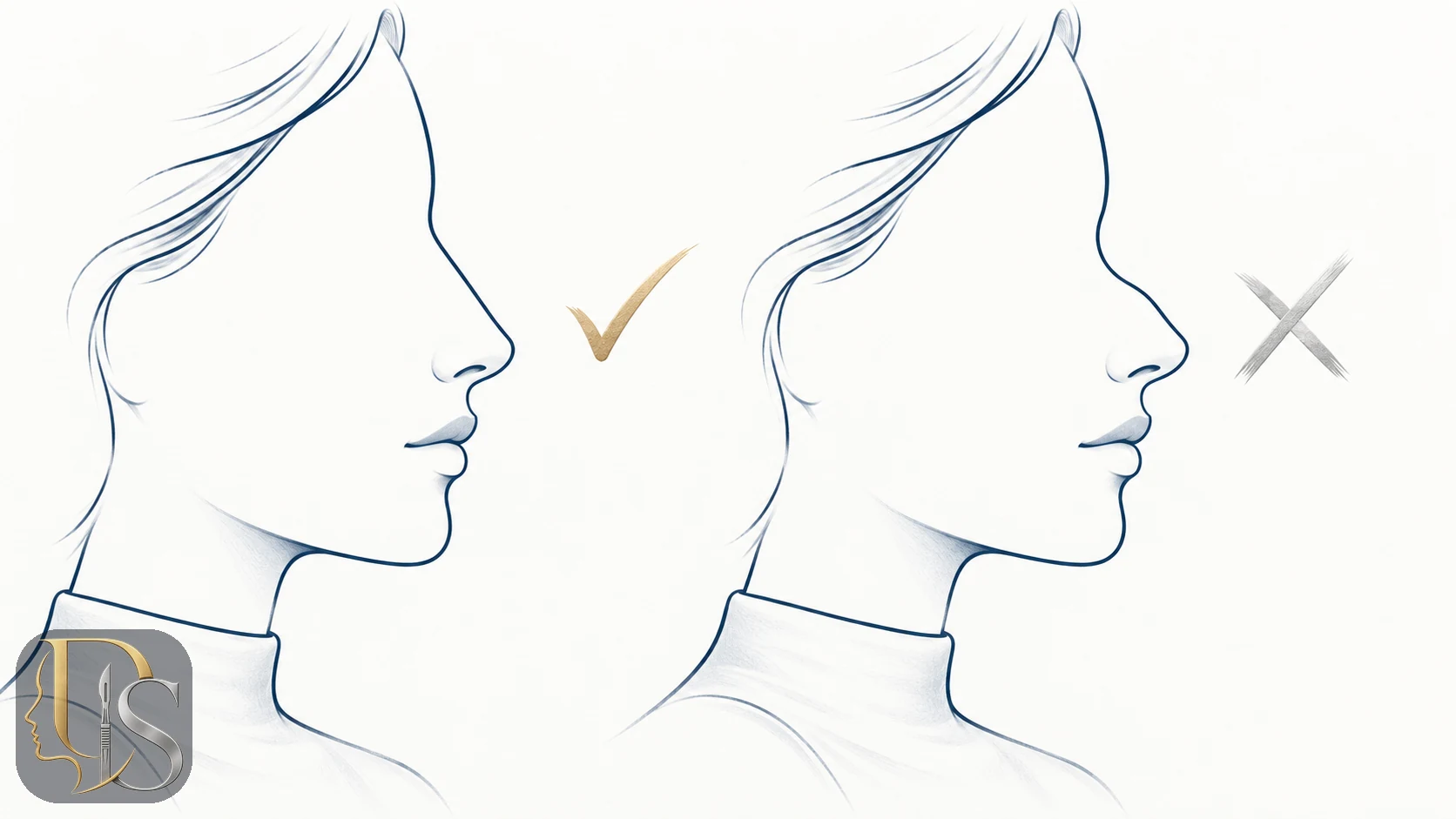
Taking too much is the commonest way a Roman nose ends up looking operated on. StatPearls is explicit that the aim is not a perfectly flat nasal skeleton: because the skin is thinnest over the bone–cartilage junction, a truly flat framework produces a visible dip once the skin settles over it. A very slight prominence is therefore left in the skeleton on purpose.
Three recognised errors
- Saddle (scooped) bridge: a dip in the middle of the bridge, from over-resection or loss of septal support.
- Fullness above the tip: if too little cartilage is removed at the lower end of the hump, the area above the tip stays full and the profile resembles a beak.
- Inverted-V: if the cartilages of the middle third are not supported after the hump is removed, a shadow shaped like an upside-down V appears on the bridge and the airway narrows.
Hump reduction and breathing are linked
The narrowest point of the nasal airway lies directly beneath the area where the hump is removed. For that reason, thin cartilage grafts are often placed on either side of the septum after the bridge is lowered, to keep that valve open. A deviated septum, if present, is corrected in the same operation.
Can a Roman Hump Be Hidden Without Surgery?
Filler does not make a hump smaller. It fills above and below it so the bridge reads as straighter, and makes the nose slightly larger overall. The StatPearls review of nonsurgical rhinoplasty considers the technique suitable for mild deficits, and states that surgical correction should be recommended for a pronounced hump and that nasal reduction cannot be achieved with fillers.
- Duration: the same source gives 6 to 12 months for hyaluronic acid fillers, so treatment has to be repeated.
- Risk: injection in the nose can occlude a blood vessel, with skin injury and, rarely, loss of vision as the consequences.
- On this site: Dr. Salmani Moghaddam does not offer filler injections; this section is here so you understand the difference between the two routes.
Recovery and When the Result Shows

Initial recovery after rhinoplasty usually takes 1 to 2 weeks, but the final line of the bridge appears later. The cast and tape typically come off after a week and bruising fades over two; according to the American Society of Plastic Surgeons, the nasal contour can take up to a year to fully refine. These are averages and vary between people.
| Period | What usually happens |
|---|---|
| First week | Cast on the nose, swelling and bruising around the eyes |
| End of week one | Cast and tape removed; the bridge is still swollen |
| Weeks two to four | Back to work and light activity, bruising fades |
| Months three to six | The true line of the bridge emerges |
| Up to a year | Final shape settles, later in thick skin |
If you are travelling to Tehran
Patients coming from another city or from abroad usually allow 7 to 10 days for the whole process — consultation, tests, surgery and the first follow-up. Ask before you fly home how follow-up is handled remotely, what photographs to send and when, and whom to contact if something concerns you.
Risks of Hump Reduction
Hump reduction carries risk like any operation, and knowing it is part of the decision. StatPearls reports complication rates of about 3 percent and revision rates of up to 15 percent for rhinoplasty, and identifies dissatisfaction with the cosmetic outcome as the greatest risk.
- General risks: bleeding, bruising and swelling, infection, and reactions to anesthesia.
- Risks specific to the bridge: visible or palpable irregularities, a saddle bridge, fullness above the tip, and an inverted-V.
- Breathing: a narrowed airway if the middle third is not supported after the hump is removed.
- Second surgery: the result is usually judged, and any revision considered, no sooner than a year after the operation.
Frequently Asked Questions
Can the hump grow back after surgery?
Bone and cartilage that have been removed do not grow back. A prominence that appears months later is usually residual swelling, scar tissue above the tip, or a slight irregularity at the edge of the bone, and should be assessed at a follow-up visit.
Is Roman nose surgery done open or closed?
Either is possible. Lowering a hump on its own can be done through a closed approach, but when precise tip work or grafting is needed at the same time, the open approach gives better visibility. According to StatPearls, swelling is milder and shorter after a closed approach.
Should a man have a Roman nose corrected?
If the curve is gentle and in keeping with the forehead and chin, there is often no reason to. If it is corrected, the aim is usually a straight bridge and an unrotated tip, not a scooped bridge and upturned tip, which look artificial on a male face.
Will the surgery fix my breathing as well?
If the breathing problem comes from a deviated septum or a narrow internal nasal valve, it can be corrected in the same operation. Removing a hump does not in itself improve breathing, and can worsen it if the middle third is left unsupported — which is why breathing is assessed as part of the examination.
From what age can a Roman nose be operated on?
Once the nasal skeleton has finished developing, which StatPearls puts at roughly 15 in girls and 17 in boys. Many surgeons prefer to wait until about 18 to be confident the decision is a settled one.
Can the hump be removed without touching the tip?
Sometimes, but lowering the bridge changes the proportions of the nose: a tip that looked in balance before may appear more prominent or more drooping once the hump is gone. The plan is therefore drawn up for the whole profile, not for the hump alone.
When Should You See a Surgeon?
If the curve of your bridge has bothered you for years, or you also have nasal obstruction, it is a reasonable time for a consultation. The visit covers the make-up of the hump, skin thickness, the septum, and how the nose relates to your forehead and chin, and you are told honestly how much change will still look natural on your face. Real outcomes are in Dr. Salmani Moghaddam's results gallery, current pricing is on the services and pricing page, and you can book a consultation online.
Sources
This article is educational and does not replace an in-person examination or consultation. Discuss any surgical decision with your own physician.
About the author
General Surgeon
Medical Council No.: 74530
Board-certified general surgeon focused on body contouring, abdominoplasty, VASER liposuction and aesthetic breast surgery.
- Board-certified general surgeon
- Member of the Iranian Medical Council
- Specialist in body contouring, VASER liposuction and aesthetic breast surgery
Medically reviewed by a physician
See the full profileQuestions about this procedure?
A consultation covers your own anatomy, what is realistically achievable, and what it involves.
Rhinoplasty (Nose Surgery)Comments
No comments yet. Be the first to write one.
Related articles
Sex After Rhinoplasty: How Many Days Should You Wait
Most surgeons allow gentle sexual activity around two weeks after rhinoplasty; higher-intensity activity is usually delayed three to four weeks. A raised heart rate and blood pressure are what increase bleeding and cartilage-shifting risk.
Read moreFever After Rhinoplasty: Normal or Warning Sign
A mild fever under 37.5°C in the first 48 hours after rhinoplasty is usually a normal response to anesthesia and surgery. Fever above 38°C, a delayed onset, or chills with foul-smelling discharge should be reported to your surgeon the same day.
Read moreShaving, Brushing Teeth, and Talking After Rhinoplasty
Gentle shaving away from the bridge, soft-brush tooth brushing, and less talking are usually fine within days of rhinoplasty, since all three move the mouth and can pressure the healing area. Waxing and threading should wait until swelling settles.
Read more