Safe Sneezing and Nose Care After Rhinoplasty

In short
After rhinoplasty, sneeze with your mouth open and do not blow your nose until your surgeon gives clearance. Use approved saline and external care for congestion, and report heavy bleeding, new severe pain, splint displacement, or visual changes.
How should you sneeze and blow your nose after rhinoplasty?

After rhinoplasty, do not suppress a sneeze; sneeze with your mouth open, and do not blow your nose until your surgeon clears you. The purpose is to reduce avoidable pressure through the healing nasal passages. Your own discharge instructions take priority because rhinoplasty techniques, septal work, cartilage grafts, splints, and bleeding risk differ between patients.
This article is educational and cannot replace an examination or instructions from your operating surgeon. If your printed postoperative plan differs from general online advice, follow the individualized plan. Reputable centers also give different timelines: the University of Mississippi advises avoiding forceful nose blowing for seven days, the University of Michigan says not to blow for two weeks, and Johns Hopkins advises avoiding it for two to three weeks. That variation is a reason to seek clearance, not to select the shortest interval.
Sneezing and nose blowing are different actions
Sneezing is involuntary, so the goal is not to prevent every sneeze. As soon as the sensation begins, relax your jaw, open your mouth, keep your head neutral or slightly forward, and allow the sneeze to escape mainly through the mouth. Do not pinch your nostrils or try to trap the sneeze in your throat. A sneeze does not automatically mean that the operation has been damaged; what matters afterward is whether there is new heavy bleeding, persistent sharp pain, a displaced splint, a sudden visible change, or another warning symptom.
Why can nose blowing be a problem early in recovery?
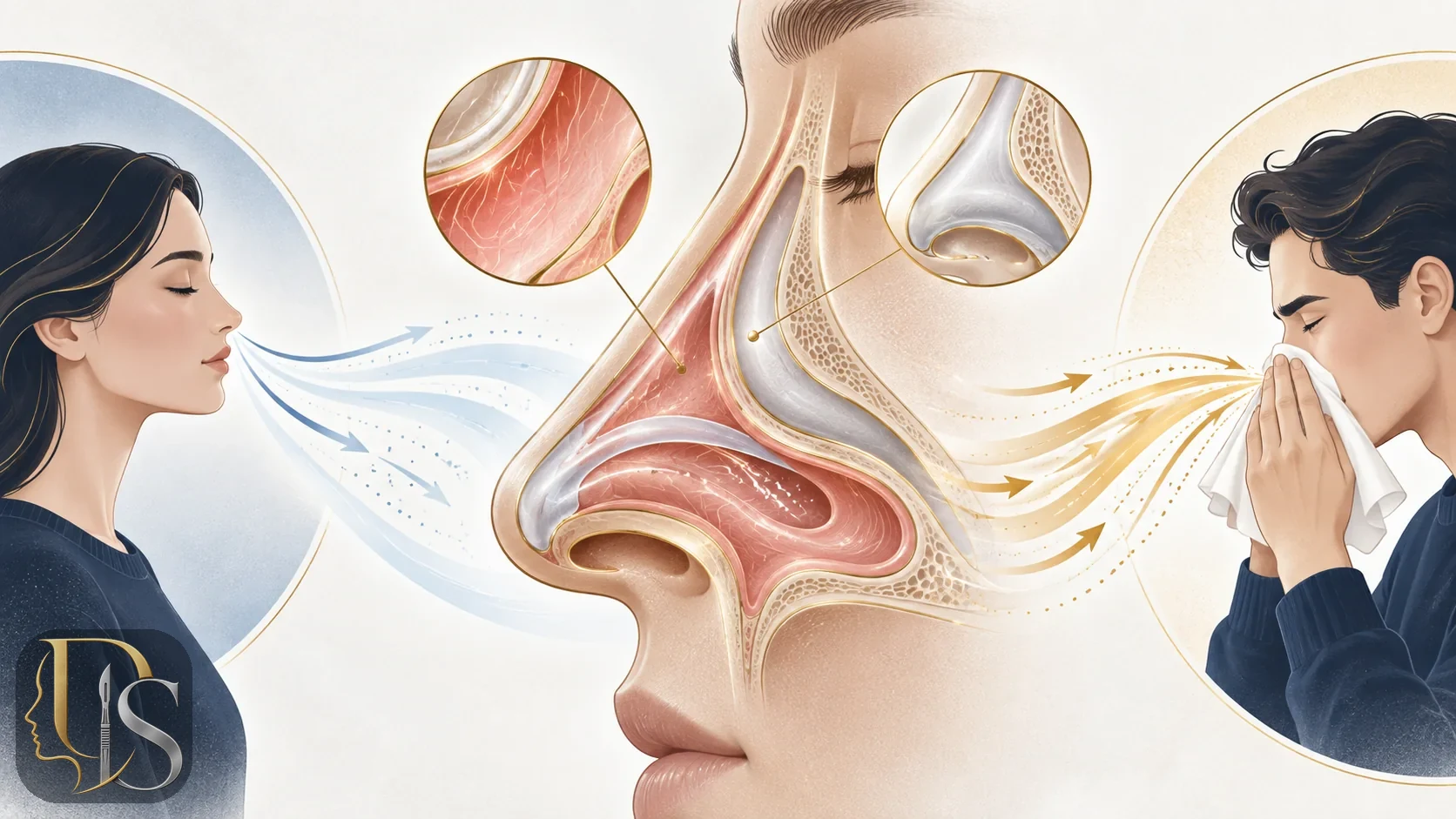
Blowing the nose, especially forcefully or while one nostril is tightly closed, raises pressure inside the nasal cavity. The lining is swollen and delicate after surgery, and incisions, septal work, grafts, or newly shaped structures are still in early healing. This is why postoperative rhinoplasty instructions routinely place a temporary restriction on nose blowing.
Bleeding and mucosal irritation
Small amounts of bloody drainage, mucus, or old blood can occur for several days. Mayo Clinic advises patients not to blow the nose and notes that limited drainage may be expected early in recovery. Blowing can disturb small healing blood vessels and trigger fresh bleeding, particularly when the nasal lining is dry or crusted.
Congestion is not always mucus
Postoperative blockage commonly comes from internal swelling, splints, packing, and dried blood. That is why trying harder may not make the nose feel clearer. The University of Mississippi notes that decongestant medication does not necessarily resolve stuffiness caused by swelling during the first postoperative days. Treating every blocked sensation as mucus can lead to repeated, unhelpful pressure.
Healing structures need protection
Rhinoplasty can involve bone, cartilage, the septum, nasal valves, or soft tissue. It would be inaccurate to claim that one gentle blow always displaces these structures, but it is sensible to avoid unnecessary pressure while tissues stabilize. The low-risk rule is to avoid blowing, forceful sniffing, and inserting objects until the operating team provides instructions.
“Gentle” blowing still requires clearance
When blowing is eventually permitted, the return should normally be gradual. The University of Michigan states that gentle blowing may begin after splint removal only if the physician has provided clearance. Removal of the external cast alone does not prove that every internal incision and structure is ready for unrestricted pressure.
When can you blow your nose after rhinoplasty?

There is no universal date. Published institutional instructions range from at least seven days to two or three weeks, while some simply say to wait until the physician gives permission. A conservative rhinoplasty approach is to avoid blowing until the first follow-up and receive explicit clearance, even if congestion is uncomfortable.
| Timeline or source | Nose-blowing advice | Practical meaning |
|---|---|---|
| First postoperative days | Usually prohibited | Dab external drainage and use only approved care |
| University of Mississippi | No forceful blowing for seven days | Use open-mouth sneezing and saline as directed |
| University of Michigan | No blowing for two weeks | Gentle blowing only after splint removal and medical clearance |
| Johns Hopkins | Avoid blowing for two to three weeks | Individual surgeon instructions remain decisive |
| Your operating surgeon | Final authority | The procedure and healing findings can change the schedule |
Why the permitted date differs
This comparison is not an invitation to choose the shortest timeline. A limited soft-tissue procedure is not identical to rhinoplasty combined with septoplasty, osteotomies, valve reconstruction, or cartilage grafting. Revision surgery, internal splints, ongoing bleeding, and medical conditions affecting clotting can also lead to different restrictions.
At follow-up, ask when and how gently to start. Once cleared, use minimal pressure and stop if fresh blood, pain, pulling, or sudden swelling occurs.
What should you do when you need to sneeze?

The central instruction is to open your mouth and avoid pinching the nose. Mayo Clinic, the University of Michigan, the University of Mississippi, and other postoperative nasal-surgery instructions recommend open-mouth sneezing to reduce pressure through the nose.
- Open early: As soon as the tickling sensation starts, relax the jaw and open the mouth rather than waiting until the final moment.
- Do not pinch the nostrils: Suppressing sound or spray by closing the nose restricts an escape route for air.
- Do not deliberately hold the sneeze: The goal is safer release, not complete suppression of the reflex.
- Cover the mouth without pressing the nose: Hold a tissue in front of the mouth, keeping pressure away from the cast, tip, and nostrils.
- Keep a stable posture: Sit or stand with the head neutral or slightly forward rather than making a sudden head movement.
- Check symptoms afterward: A small amount of expected drainage differs from persistent bright bleeding, new severe pain, or visible splint displacement.
What to do after the sneeze
If several sneezes occur in a row, breathe calmly through the mouth between them and move away from the likely trigger, such as dust, smoke, perfume, or very dry air. Do not start a new nasal spray or oral medication solely to stop the episode unless the surgical team has approved it.
How can you manage congestion and drainage without blowing?

Early congestion should be managed by maintaining moisture and cleaning only what your surgeon has authorized, not by forcing the airway open. Common elements include saline mist, loose drip gauze, external dabbing, a clean humidifier, hydration, and postoperative office cleaning. Irrigation method and timing must match your operation.
Saline mist is not the same as forceful irrigation
Stanford Health Care includes nasal saline spray in its postoperative nasal-surgery instructions to help remove crusts and dried blood while maintaining moisture. A gentle mist is not equivalent to a squeeze bottle, powered device, neti pot, or syringe. Patients with splints, packing, grafts, or combined procedures should use only the method specifically approved by the surgeon.
Dab the outside instead of cleaning deeply
If drainage reaches the nostril rim, gently blot it with clean gauze or soft tissue. Do not rotate tissue inside the nostril, pick crusts, or insert cotton swabs deeply. The University of Mississippi specifically advises against putting anything into the nose unless directed.
Keep the drip pad loose
A small gauze pad may be placed beneath the nostrils during the first hours or days. Mayo Clinic advises that it should not be held tightly against the nose. Replace it as instructed without pulling on the cast or skin. Repeated rapid saturation with bright red blood is different from light, decreasing drainage and should be reported.
Use clean humidification and adequate fluids
Dry air can worsen crusting and throat discomfort from mouth breathing. A bedside humidifier may help, but it must be cleaned correctly to avoid dispersing contaminants. Fluids can reduce dry-mouth discomfort unless another medical condition requires restriction.
Avoid forceful sniffing
Instructions about gentle sniffing vary. A Johns Hopkins septal-surgery sheet permits gentle sniffing but says not to blow until instructed, while the University of Mississippi warns against sniffing or forceful nasal breathing. The practical shared rule is to avoid force. Ask the surgeon whether a gentle inward sniff is appropriate in your specific case.
What if allergies, a cold, or repeated sneezing occur?

Allergies and respiratory infections can increase sneezing, drainage, and the urge to blow, but they do not make unsupervised medication changes safe. Reduce environmental triggers, continue or restart previous allergy treatment only according to the surgical plan, and report severe symptoms, fever, breathing difficulty, or foul drainage.
Reduce exposure to triggers
Avoid smoke, vaping, dusty rooms, strong fragrance, and harsh cleaning fumes during early recovery. Fresh bedding, reasonable humidity, and having someone else perform dusty cleaning may reduce symptoms. If animals trigger allergies, keep them away from the sleeping area while the nose is most sensitive.
Confirm oral allergy medicines
Ask when to resume an existing antihistamine. Some products cause drowsiness, which may be additive with prescription pain medicine or sedatives. Give the clinic the exact product name, strength, and dosing schedule rather than saying only “allergy tablet.”
Do not overuse decongestant sprays
Some hospital instructions allow a topical decongestant for limited bleeding or a short, specific period. This is not blanket permission for prolonged use. The exact spray, frequency, and duration should come from the surgeon because inappropriate use can worsen congestion or conflict with the postoperative plan.
Do not borrow a sinus-surgery routine
Large-volume irrigation may be central after some sinus operations, while rhinoplasty with structural work and splints can require a different plan. Advice from a friend who had sinus surgery may therefore be unsuitable. Follow the protocol written for your exact procedure.
What if you accidentally sneezed incorrectly or blew your nose?

An accidental sneeze or brief blow does not by itself prove that the surgical result has been harmed. Stop adding pressure, remain calm, and check for meaningful symptoms. Contact the surgeon promptly if there is substantial fresh bleeding, persistent new pain, obvious cast or splint displacement, a sudden visible change, or a visual symptom.
Afterward, look rather than press. Do not repeat a blow to “finish clearing” the airway, push the nose from side to side, or insert a tool. Sit upright, follow the discharge plan, and provide the clinic with the event time, symptoms, and a no-touch photograph if requested.
Which warning signs require medical advice?
Warning signs include heavy or persistent bleeding, uncontrolled pain, fever, a sudden visual change, rapidly increasing or one-sided swelling, obvious new deformity, displaced splints, breathing difficulty, or persistent clear watery drainage. Johns Hopkins and university postoperative instructions identify excessive bleeding, fever, visual disturbance, and unusual symptoms as reasons to alert the surgical team.
Significant bleeding
Limited blood-stained drainage can occur early, but ongoing bright-red flow, rapid saturation of multiple gauze pads, large clots, dizziness, or weakness requires assessment. When calling, state when it began, whether it is slowing, and what measures from the discharge plan you have already used.
Visual symptoms or rapidly increasing eye swelling
Blurred vision, double vision, eye pain, reduced eye movement, or rapidly increasing swelling around the eye should not be dismissed as a simple effect of sneezing. Johns Hopkins advises immediately alerting the surgical team about visual disturbance. If symptoms are severe or the surgeon cannot be reached, urgent assessment is appropriate.
Fever, worsening pain, or foul drainage
Fever, pain that becomes worse rather than gradually improving, a new unpleasant odor, or pus-like drainage may indicate infection or another complication. Do not use leftover antibiotics. Report the measured temperature, timing, symptoms, and current medicines.
Sudden structural change
Postoperative swelling can be uneven, but a sudden change immediately after pressure, impact, or a distinct painful event deserves review. Do not attempt to straighten the nose yourself. Take a no-touch photograph and allow the surgeon to decide whether an earlier examination is needed.
A practical recovery plan to reduce nasal pressure
A simple routine lowers the chance of reflexively blowing, touching, or exposing the nose to irritants. Keep supplies nearby, use only prescribed care, maintain a smoke-free environment, and make the surgical team’s contact information easy to find. The aim is not to eliminate every symptom but to manage symptoms without avoidable pressure.
Prepare the recovery space
- At the bedside: Keep soft tissues, clean gauze, water, prescribed medicines, and discharge instructions within reach.
- During sleep: Elevate the head as directed and sleep on the back to reduce accidental contact with pillows.
- In the morning: Use only the approved saline or cleaning routine; do not remove crusts by force.
- During the day: Follow restrictions on bending, straining, lifting, and exercise, all of which can increase bleeding or swelling.
- When a sneeze starts: Open the mouth, cover without pressing the nose, and do not pinch the nostrils.
- When blocked: Choose approved saline, humidification, external dabbing, and clinic advice rather than forceful blowing.
- For follow-up: Record symptoms, medication use, and the time of any bleeding episode so advice can be based on accurate details.
If you are still planning surgery, tell the surgeon about seasonal allergies, asthma, chronic sinus symptoms, nasal sprays, and frequent sneezing. The rhinoplasty service page explains the broader procedure and consultation pathway. International or out-of-town patients can use the consultation booking page to discuss travel and follow-up arrangements before choosing dates.
Frequently Asked Questions
Can one sneeze ruin a rhinoplasty result?
An isolated sneeze, particularly with the mouth open and no subsequent bleeding, new pain, splint displacement, or obvious structural change, does not usually prove that the result has been harmed. Individual assessment is still necessary when symptoms develop. Contact the surgeon if anything changed or if the event was unusually forceful.
What should I do if I sneezed with my mouth closed?
Do not panic or squeeze the nose to test it. Stop further pressure and look for fresh persistent bleeding, new pain, visible change, splint displacement, or visual symptoms. If none occurs, routine care often continues; if a symptom appears or concern persists, contact the surgical office the same day.
Is sniffing mucus back allowed?
Institutional advice varies: some permit a gentle sniff, while others warn against forceful sniffing or nasal breathing. Avoid any strong inward pressure and ask the operating surgeon what is appropriate. Approved saline mist and external dabbing are often safer than repeated forceful sniffing.
Can I blow after the cast is removed?
Not automatically. The external cast protects the outside, while the nasal lining, septum, sutures, and deeper structures may still be healing. The University of Michigan links gentle blowing to both splint removal and physician clearance. Ask explicitly before starting.
Which medicine can stop allergy sneezing?
There is no single safe choice for every patient. Existing allergy medicine, other health conditions, and postoperative pain or sedating medicines need to be considered together. Do not independently start or stop an antihistamine, decongestant spray, or steroid spray; confirm the exact product with the surgical team.
Is gentle nose blowing safe on the first day?
Rhinoplasty instructions generally say no. “Gentle” does not remove pressure entirely, and first-day blockage is commonly caused by swelling, dried blood, packing, or splints. Avoid blowing until the surgeon gives explicit permission.
What if my nose feels completely blocked?
Marked blockage can occur from swelling or splints, but contact the team if it is worsening, strongly one-sided, or associated with severe pain, fever, or bleeding. Do not insert tools or perform high-pressure irrigation unless that method was specifically prescribed.
When should you contact the surgeon?
Contact the surgeon whenever the timeline for nose blowing, saline use, allergy medication, or drainage is unclear. Seek prompt advice for heavy or persistent bleeding, fever, uncontrolled pain, visual change, rapid swelling, persistent clear drainage, splint displacement, breathing difficulty, or a sudden visible change in the nose.
For non-urgent questions, provide the postoperative day, exact symptom, duration, and current medicines. For severe or worsening symptoms, use the emergency number in the discharge instructions rather than relying only on email or messaging. Current service information is available on the services and fees page, but postoperative medical decisions must come from the treating team.
Sources
- Mayo Clinic — Rhinoplasty
- Johns Hopkins Medicine — Rhinoplasty
- University of Michigan Health — Septo/Rhinoplasty Post-Operative Instructions
- University of Mississippi Medical Center — Postoperative Care of Rhinoplasty
- UNC Health — Discharge Instructions for Rhinoplasty and Nasal Surgery
- Stanford Health Care — Nasal Surgery Postoperative Instructions
This article is educational and does not replace an in-person examination or consultation. Discuss any surgical decision with your own physician.
About the author
General Surgeon
Medical Council No.: 74530
Board-certified general surgeon focused on body contouring, abdominoplasty, VASER liposuction and aesthetic breast surgery.
- Board-certified general surgeon
- Member of the Iranian Medical Council
- Specialist in body contouring, VASER liposuction and aesthetic breast surgery
Medically reviewed by a physician
See the full profileQuestions about this procedure?
A consultation covers your own anatomy, what is realistically achievable, and what it involves.
Rhinoplasty (Nose Surgery)Comments
No comments yet. Be the first to write one.
Related articles
Shaving, Brushing Teeth, and Talking After Rhinoplasty
Gentle shaving away from the bridge, soft-brush tooth brushing, and less talking are usually fine within days of rhinoplasty, since all three move the mouth and can pressure the healing area. Waxing and threading should wait until swelling settles.
Read moreShowering and Washing Your Face After Rhinoplasty
After rhinoplasty, showers are usually replaced with a shallow bath or sponge washing until the splint or tape comes off, keeping water away from the face. Once removed, your surgeon's approval allows lukewarm showers without pressure on the nose.
Read moreNostril Asymmetry After Rhinoplasty: Causes and Timeline
Nostril asymmetry is common right after rhinoplasty due to uneven swelling and internal splints, and usually fades within three to six months. Asymmetry still visible after a year usually has a structural cause and needs an in-person evaluation.
Read more