
Extended vs Fleur-de-Lis Abdominoplasty: When Vertical Is Needed

In short
An extended abdominoplasty carries the incision toward the flanks to remove tissue beside the hips. Fleur-de-lis adds a vertical incision for skin loose both across and along the abdomen, typically after major weight loss.
How do extended and fleur-de-lis abdominoplasty differ from a standard tummy tuck?
An extended abdominoplasty is a standard full tummy tuck whose incision continues toward the flanks, so excess tissue beside the hips is removed too. A fleur-de-lis abdominoplasty adds a vertical midline incision to the horizontal one, and is used when skin is loose both across and along the abdomen. This article is educational and does not replace an in-person examination.
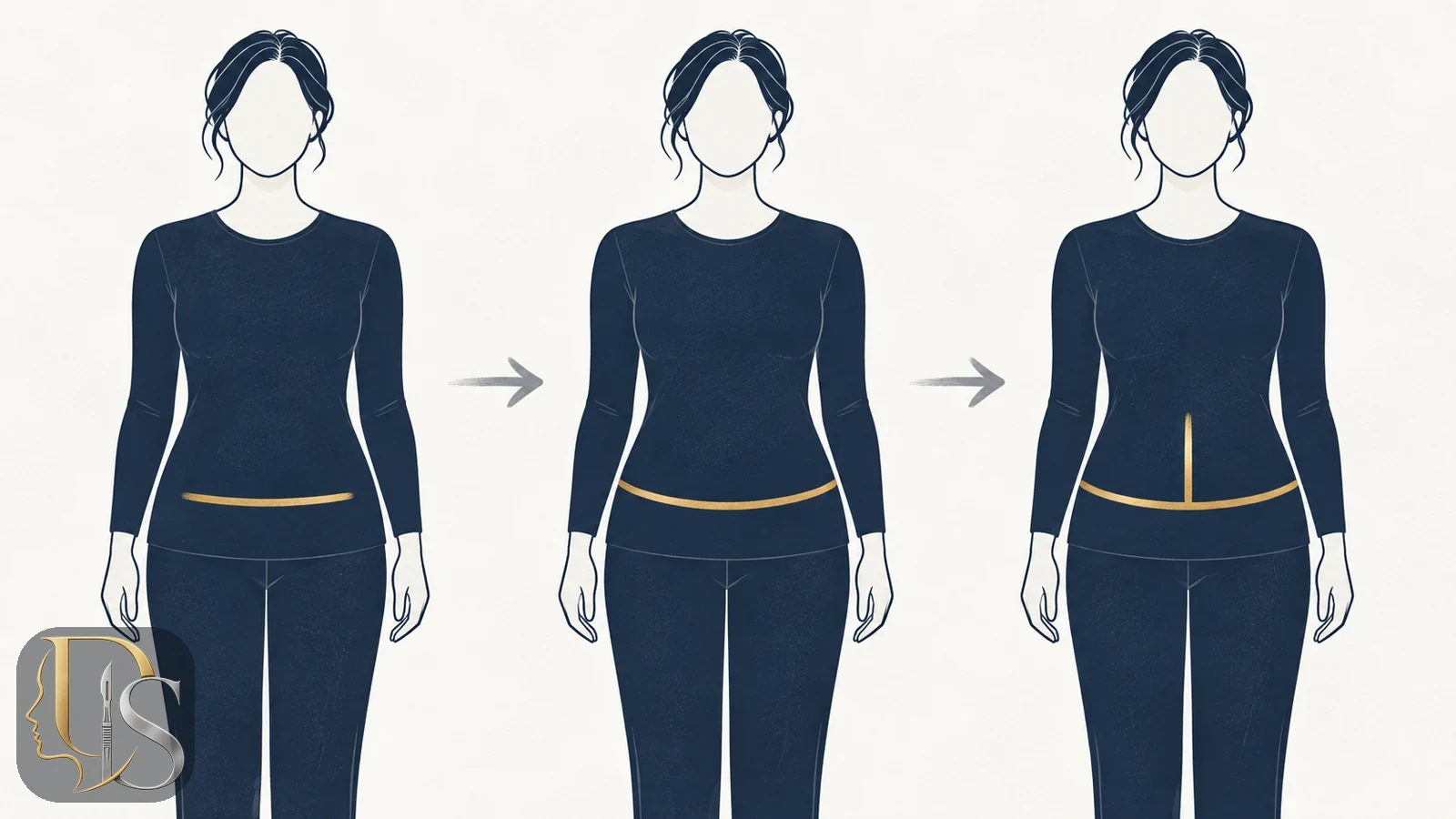
Both are enlarged versions of the full abdominoplasty, designed for an abdomen that a standard horizontal incision cannot correct on its own. One basic point first: surgeons assess skin, fat and muscle as three separate layers and pick the operation from that assessment. The "abdominolipoplasty" classification described by Matarasso is built on exactly that principle.
The types of abdominoplasty in one table
| Operation | Incision | Main problem it solves |
|---|---|---|
| Mini abdominoplasty | Short, below the navel | Limited lower-abdominal overhang |
| Full (classic) | Horizontal, hip to hip | Loose abdominal skin and muscle separation |
| Extended | Horizontal, continued to the flanks | Excess skin and fat beside the hips and flanks |
| Fleur-de-lis | Horizontal plus vertical | Excess skin in both width and length, often after major weight loss |
| Circumferential body lift | Belt-line around the trunk | Laxity across abdomen, flanks and back |
If a mini is still on your list, read the article on mini abdominoplasty and who is a candidate. Here we cover only the two larger versions.
What is an extended abdominoplasty and who needs it?
An extended abdominoplasty is needed when, besides the skin at the front, excess fat and skin at the flanks and hip area create a visible bulge. Instead of ending near the hip, the horizontal incision of a full tummy tuck is carried toward the posterior axillary line so that region is excised directly.

The surgical paper describing the technique considers it best for patients with a significant excess of tissue at the lateral hip that produces an outward convexity seen from the front, back or at an angle. The author describes this excess as a soft-tissue "dog ear" made of skin and fat both deep and superficial to the superficial fascial system, which a standard horizontal incision does not remove well.
What does a longer incision mean?
A longer incision means the scar line runs further toward the flank. In return, if the flanks truly carry excess tissue, the same incision avoids leaving a bunching or bulge beside the scar. If the flank excess is only fat and the skin is elastic, liposuction at the same sitting may be enough instead of lengthening the incision. The decision comes from examining that particular body.
Who does not need it?
If the bulge is only at the front and the flanks are flat, extending the incision lengthens the scar for nothing. Someone whose laxity runs along the abdomen rather than across it gains nothing from horizontal extension; a vertical version may need to be considered instead.
What is fleur-de-lis and why does it add a vertical cut?
A fleur-de-lis abdominoplasty has a vertical midline incision in addition to the horizontal one; the name comes from the lily-like (inverted T) shape. It is considered when abdominal skin is loose both across and along the abdomen and a horizontal incision can correct only one of the two.
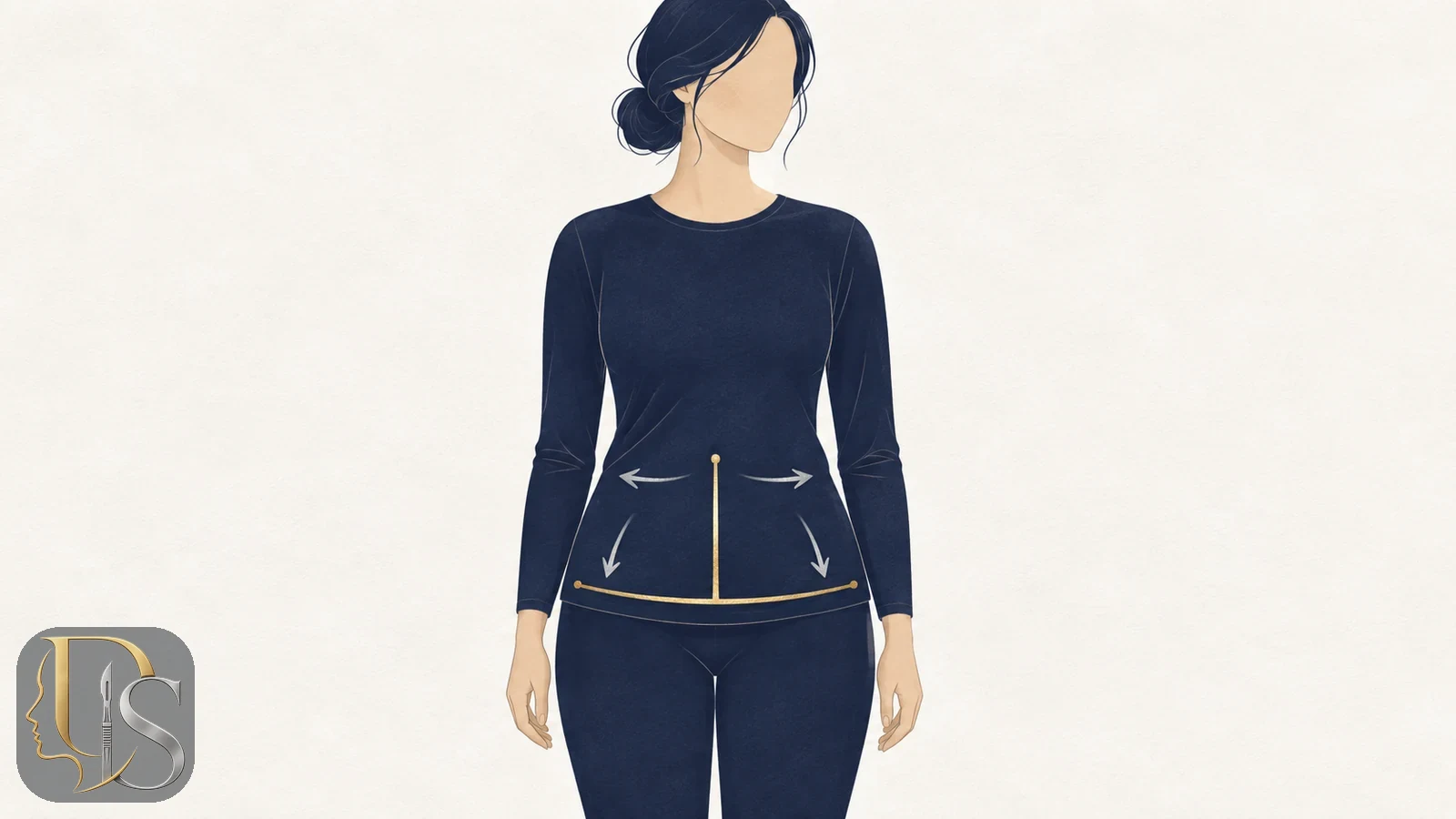
A review by Mitchell and Rubin calls vertical abdominoplasty a safe and effective way to correct abdominal contour in individuals with excess soft tissue in both the vertical and transverse directions. The authors add that the evidence is limited, and report complication rates comparable to a standard transverse abdominoplasty. A more recent review by Mendes and colleagues describes the operation as giving the best correction across directions and superior waist definition in massive-weight-loss patients.
Who usually needs the vertical cut?
Patients after very large weight loss, for example after bariatric surgery, are the most common group, because their skin does not only sag downward; it is also loose across the width, and the waist does not narrow. If you are one of them, see the article on abdominoplasty after gastric sleeve for the right timing.
What is the price of the vertical incision?
A vertical incision means a scar in the middle of the abdomen that is hidden by everyday clothing but visible without it. The patient must make a clear trade: a better waist and abdominal shape against a vertical scar. Many patients after major weight loss accept it, because the excess skin bothers them more. The T-point, where the horizontal and vertical incisions meet, is where healing is slowest; a study of 76 patients attributes wound separation and delayed healing there, and seroma, to tension on the tissue edges and reduced microvascular perfusion, and proposes a modified technique to reduce this.
How do you know which incision suits you?
The choice comes from three observations: the direction of the excess skin (only downward, out to the flanks, or across), the condition of the muscles (a gap above the navel), and the quality of the skin and fat. With the patient standing and the skin pinched in folds, the surgeon can tell in which directions it is in excess.

Questions the examination answers
- Is the skin hanging only downward, or is it also loose across? The answer separates horizontal from vertical.
- Is the excess beside the hip skin, or fat only? The answer separates liposuction from an extended incision.
- Where and how wide is the muscle gap? The StatPearls chapter on diastasis recti explains why it matters.
- How stable is your weight? Continuing weight loss undermines any choice.
When abdominoplasty is not enough: body contouring and panniculectomy
If laxity wraps around the trunk (abdomen, flanks, back), body contouring operations such as a circumferential lift come into play. A panniculectomy is a different operation: per StatPearls, the hanging skin and fat (the panniculus) are removed but the abdominal wall muscles are not tightened, so it differs from a cosmetic abdominoplasty and is used mostly to relieve functional problems such as recurrent skin infections.
Risks and limits of the larger operations
The larger the operation, the larger the area of tissue that is released, and the higher the chance of fluid collection (seroma), hematoma, wound separation and infection. Weight fluctuation, smoking and underlying conditions such as diabetes also play a part. For the post-weight-loss group, a separate review on the safety of fleur-de-lis in this population has been published, listed in the sources.

Like any major surgery, these operations demand careful patient selection and medical preparation: for example diabetes under control, stopping smoking and a confirmed nutritional status. The decision is never made from sample photographs but from examination and a review of the patient's general health.
The scar: what to know beforehand
Longer incisions mean longer scars. A scar is usually red and raised in the first months and generally fades over months to years; healing pattern, sun protection and skin genetics all play a part. At consultation the surgeon should show you the planned position and approximate length of the scar on your own body.
Where the incision sits, how long the scar lasts and how to fade it are covered in tummy tuck scar: where it sits, how long it lasts.
Recovery after a larger operation
After an extended or fleur-de-lis abdominoplasty, recovery is usually longer and restrictions greater than after a mini: the patient wears a compression garment, walks a little bent at the waist for a while and avoids heavy activity until the surgeon permits it. Care taken over fluid collection and wound healing has a direct effect on the result.

- Light walking from the first days: to reduce the risk of blood clots.
- The garment: as directed by the surgeon and for the period set.
- No smoking: it reduces blood flow to the skin and endangers healing.
- Regular follow-up: to monitor fluid collection and the sutures.
Return to work and exercise is set by the surgeon according to your progress; no single figure applies to everyone.
Frequently Asked Questions
How does an extended abdominoplasty differ from a full one?
An extended abdominoplasty is a full tummy tuck whose incision is lengthened toward the flanks so that excess skin and fat beside the hips are removed too. In a standard full operation the incision is usually hip to hip and flank excess is left uncorrected. The choice depends on the patient's flanks.
What is a fleur-de-lis abdominoplasty and why is there a vertical scar?
It is an abdominoplasty with a vertical midline incision in addition to the horizontal one. It is intended for skin that is loose both across and along the abdomen, and the vertical scar is the price paid to correct both directions.
Is fleur-de-lis riskier than a standard abdominoplasty?
According to the Mitchell and Rubin review, its complication rate is reported as comparable to a standard transverse abdominoplasty, although the evidence is limited. The T-point is a common site of delayed wound healing. Each patient's real risk depends on weight, smoking and underlying disease, and needs to be reviewed at consultation.
After major weight loss, is fleur-de-lis always necessary?
Not always. Some patients are served well by a full or extended abdominoplasty, while others whose laxity also runs across the width need the vertical version. The type of laxity found on standing examination decides.
Can liposuction replace the flank incision?
Only when the flank excess is mostly fat and the skin is elastic. If excess skin is present, liposuction does not remove it and the result is incomplete; an extended incision or body contouring then works better.
How much do these operations cost?
The cost depends on the extent of surgery, operating time, type of anesthesia, any liposuction done at the same time and the hospital, and it changes over time. Current prices are on the price list; for a breakdown of the bill see the article on abdominoplasty cost.
When should you see a doctor?
If excess skin on the abdomen or flanks after major weight loss bothers you, or if its shape affects comfort and skin hygiene, consult a surgeon before deciding. After surgery, report high fever, strong redness and warmth, pus-like discharge, increasing pain or sudden one-sided swelling to the surgical team at once. To arrange a consultation, use the booking page.

Sources
- Shestak KC — The extended abdominoplasty (Clin Plast Surg, 2014)
- Mitchell RT, Rubin JP — The Fleur-De-Lis abdominoplasty (Clin Plast Surg, 2014)
- Mendes FH et al. — Finesse in Fleur-de-lis Abdominoplasty (Clin Plast Surg, 2024)
- DeSerres JJ et al. — Safety of Fleur-de-lis Abdominoplasty after Massive Weight Loss (J Plast Reconstr Aesthet Surg, 2021)
- Ziegler UE et al. — Modified Fleur-de-lis Abdominoplasty for Massive Weight Loss Patients (Ann Plast Surg, 2017)
- Matarasso A et al. — Abdominoplasty: classic principles and technique (Clin Plast Surg, 2014)
- StatPearls — Panniculectomy
This article is educational and does not replace an in-person examination or consultation. Discuss any surgical decision with your own physician.
About the author

General Surgeon
Medical Council No.: 74530 · Verify in the Medical Council register
Specialist in general surgery focused on rhinoplasty, body contouring, abdominoplasty, VASER liposuction and aesthetic breast surgery.
- Specialist in general surgery
- Member of the Iranian Medical Council
- Specialist in body contouring, VASER liposuction and aesthetic breast surgery
Medically reviewed by a physician
See the full profileQuestions about this procedure?
A consultation covers your own anatomy, what is realistically achievable, and what it involves.
Abdominoplasty (Tummy Tuck)Comments
No comments yet. Be the first to write one.
Related articles
Mini Abdominoplasty: What It Is and Who Is Truly a Candidate
A mini abdominoplasty removes only skin and fat below the navel. A good candidate has stable weight and laxity confined to the lower belly; loose skin above the navel or a wide muscle gap usually needs a full tummy tuck.
Read moreAbdominoplasty With a Cesarean: Why Most Surgeons Say No
Combining abdominoplasty with a cesarean is technically done at some centers, but most surgeons avoid it: the abdominal wall is still swollen and changing, and combining two major surgeries raises bleeding, infection, and clotting risk.
Read moreAbdominoplasty After Childbirth: How Many Months to Wait
The right timing for abdominoplasty after childbirth is usually 6 to 12 months, once weight has been stable for at least three months, breastfeeding has ended, and no future pregnancy is planned. All four conditions must hold at once.
Read more