
Mini Abdominoplasty: What It Is and Who Is Truly a Candidate

In short
A mini abdominoplasty removes only skin and fat below the navel. A good candidate has stable weight and laxity confined to the lower belly; loose skin above the navel or a wide muscle gap usually needs a full tummy tuck.
What does a mini abdominoplasty actually do?
A mini abdominoplasty is the limited version of a tummy tuck: it removes excess skin and fat in the lower abdomen, between the navel and the pubic line, and pulls the skin above it downward. The incision is shorter and sits low, near the underwear line. The upper abdomen is largely left alone. This article is educational and does not replace an in-person examination.

The main difference from a full abdominoplasty is how much gets corrected. In a full tummy tuck, skin and fat are released from the ribs to the pubis, the navel is repositioned and the muscles can be tightened along their whole length. In a mini, only the lower half is treated. If your problem is confined to the lower half, that limit is an advantage. If it is not, it is a flaw.
Mini versus full in one table
| Factor | Mini abdominoplasty | Full abdominoplasty |
|---|---|---|
| Area corrected | Below the navel | Whole abdomen, ribs to pubis |
| Navel | Usually left in place, or moved slightly | Freed and re-inset |
| Muscle tightening | Limited to the lower part | Full length, if needed |
| Incision | Shorter | Longer, usually hip to hip |
| Suits | Mild to moderate laxity below the navel | Laxity across the abdomen or a wide muscle gap |
The general principles of both operations are covered on the abdominoplasty service page. This article stays on a single question: who gets a good result from a mini, and who does not.
Who is really a candidate for a mini abdominoplasty?
A good candidate is someone whose weight is close to their ideal and stable, whose extra skin sits almost entirely below the navel, and whose upper abdomen is firm. A surgical review of the umbilical-float technique describes the best candidates as postpartum women with a normal body mass index, mild to moderate skin excess below the navel and minimal to mild excess above it.

In practice, four features usually go together:
- Stable weight. Weight swings after surgery erode the result. The American Society of Plastic Surgeons (ASPS) also advises postponing a tummy tuck if you plan major weight loss or future pregnancies.
- Skin excess below the navel. A fold or overhang that sits above a cesarean scar or the pubic line and does not change with exercise.
- A firm upper abdomen. If the skin above the navel is also loose, pulling skin down from below will not flatten it.
- A small muscle gap, or none. If the upper belly bulges, the problem is usually the muscles, not the skin below the navel.
How does an exam show that a mini is enough?
The surgeon usually examines you standing and lying down. Pinching the skin above and below the navel, and gently drawing the lower skin downward, gives an estimate of how much can be removed and where the navel will sit afterwards. This simple clinical test is more reliable than any photo you see online, because it assesses your own body in several positions.
The navel: the key technical detail
Because the skin is pulled down in a mini, the navel ends up slightly lower relative to the trunk. In the "umbilical float" technique it moves about 1 to 3.5 cm. In a study of 31 patients, the final navel was judged "too low" in 5 (about 18.5 percent), all of whom had a navel already level with the anterior superior iliac spine. The authors therefore recommend that the navel start at or above the level of the iliac crest and that at least 10 cm of hairless skin remain between the scar and the navel. Put simply: if your navel is already low, a mini is probably not the right operation.
Who is not a candidate for a mini abdominoplasty?
A mini is unsuitable for people with laxity across the whole abdomen, a muscle gap above the navel, or major weight loss, because it does not treat the area above the navel. In these cases a mini leaves a result the patient is unhappy with, and a second operation is often needed.

Situations where a mini is usually not enough
- Loose skin above the navel. It stays folded after the lower skin is removed.
- A wide rectus diastasis. A separation of the rectus muscles above the navel can only be corrected by working along the full length of the abdomen. See the StatPearls chapter on diastasis recti and the article on belly sagging after cesarean.
- Major weight loss, for example after gastric sleeve. Excess skin usually runs in all directions; the article on abdominoplasty after gastric sleeve explains why timing and extent differ.
- Visceral fat. A bulge caused by fat around the internal organs cannot be removed by any type of abdominoplasty, because it lies beneath the muscles.
- A navel that is already low. The study above links this to a higher chance of a low-looking final navel.
- A future pregnancy. Pregnancy stretches the skin and muscle again.
When liposuction alone is enough
If the skin is elastic and the problem is only localized fat below the navel, you may not need an incision at all. Liposuction removes fat but not excess skin, so it works well only where the skin will retract by itself. A mini combined with liposuction treats both problems together. The decision is made body by body.
How suitable is a mini abdominoplasty after a cesarean?
A mini suits the aftermath of a cesarean when the overhang sits only above the cesarean scar. When skin and fat are confined to that area, weight is stable and the muscles above the navel are sound, a mini can be the most logical choice, and the new incision can often follow the old scar.

Timing matters. The body needs enough time to recover after pregnancy; the article on abdominoplasty timing after childbirth explains the window. A mini can also be performed at the time of a cesarean, but most surgeons advise against it, for reasons given in the article on abdominoplasty combined with cesarean.
What if a full abdominoplasty is needed later?
Having a mini does not close the door on a full operation. A case series of 18 patients who had a full abdominoplasty after an earlier limited operation (or umbilical hernia repair) found that all healed without umbilical ischemia or necrosis. The series is small and is not a universal promise, but it shows that a second step is feasible. More importantly, if it is already clear that a full operation will be needed, two surgeries add cost and risk for no reason.
What are the operation and recovery like?
A mini is usually done under anesthesia, takes less operating time than a full abdominoplasty, and its recovery is usually shorter. The type of anesthesia, the length of stay and the time to return to work depend on the technique, the extent of surgery and the individual patient, and are settled at consultation.

The general steps
- Marking. With the patient standing, the incision line and the area of removal are marked.
- Incision and release. The skin and fat below the navel are separated from the muscle layer.
- Muscle repair, if needed. Only the lower portion is tightened.
- Removal and closure. The excess skin is removed and the remaining skin is drawn down and sutured.
- Dressing and garment. A special compression garment is used to control swelling.
Recovery and care
In the first weeks, swelling and a pulling sensation in the skin are normal. Light walking is encouraged from the first days, while heavy lifting and abdominal exercise are avoided until the surgeon allows them. Full swelling can take months to settle, so the final result cannot be judged early. Exact time frames are set by your surgeon according to how you heal.
Risks and limits of a mini abdominoplasty

Like any operation, a mini carries risks: fluid collection (seroma), bruising or hematoma, infection, widened scars, asymmetry and changes in the navel. How likely and how severe these are depends on technique, weight, smoking and aftercare. Smoking reduces blood flow to the skin and raises the risk of healing problems, so most surgeons ask patients to stop before and after surgery.
The central limit is equally clear: a mini does not correct what is above the navel. A patient who goes in expecting a "completely flat belly" while their anatomy needs a full operation will find the result incomplete. For that reason, the honest answer from a surgeon is sometimes that a mini is not enough for you.
Frequently Asked Questions
What is the difference between a mini and a full abdominoplasty?
A mini treats only the skin and fat below the navel with a shorter incision. A full abdominoplasty treats the whole abdomen, repositions the navel and tightens the muscles along their full length. The choice depends on where the excess skin is and on the condition of the muscles, not on patient preference alone.
Who is a mini abdominoplasty suitable for?
It suits people with stable weight, mild to moderate laxity confined to the area below the navel, and a firm upper abdomen with healthy muscles; typically women with a lower-abdominal overhang after childbirth or cesarean. Final assessment is only possible in person.
Does the navel change after a mini abdominoplasty?
It can. Because the skin is drawn downward, the navel sits slightly lower. In a study of 31 patients, the final navel was judged slightly low in about 18.5 percent, all of whom started with a navel level with the iliac spine. That is why navel position is assessed before surgery.
Can I get pregnant after a mini abdominoplasty?
Medically it is possible, but pregnancy can undo some of the result. ASPS advises women who may become pregnant to postpone a tummy tuck, because renewed stretching of skin and muscle can reduce the outcome.
What if a mini is not enough?
Depending on the problem, a full abdominoplasty is needed, or in the case of laxity in more directions, such as after major weight loss, a more extensive technique. The article on types of abdominoplasty explains which operation fits which situation.
How much does a mini abdominoplasty cost?
The cost depends on the operation, any liposuction done at the same time, anesthesia and the hospital fee, and it changes over time. Current prices for each procedure are on the price list, and the final figure is set after examination.
When should you see a doctor?

If your abdomen has a shape after pregnancy, cesarean or weight loss that does not change with exercise and diet, consult a surgeon before deciding anything, so it is clear whether the problem is skin, muscle or fat. If after surgery you have a high fever, strong redness and warmth, pus-like discharge, increasing pain or sudden one-sided swelling, contact the surgical team immediately. To find out where you stand, you can request a consultation through the booking page.
Sources
- Wan D, Hubbard BA, Byrd HS — Achieving Aesthetic Results in the Umbilical Float Mini-Abdominoplasty (Plast Reconstr Surg, 2019)
- Dean RA, Dean JA, Matarasso A — Secondary Abdominoplasty: Management of the Umbilicus after Prior Stalk Transection (Plast Reconstr Surg, 2019)
- Matarasso A et al. — Abdominoplasty: classic principles and technique (Clin Plast Surg, 2014)
- American Society of Plastic Surgeons — Tummy Tuck
- StatPearls — Abdominoplasty
This article is educational and does not replace an in-person examination or consultation. Discuss any surgical decision with your own physician.
About the author
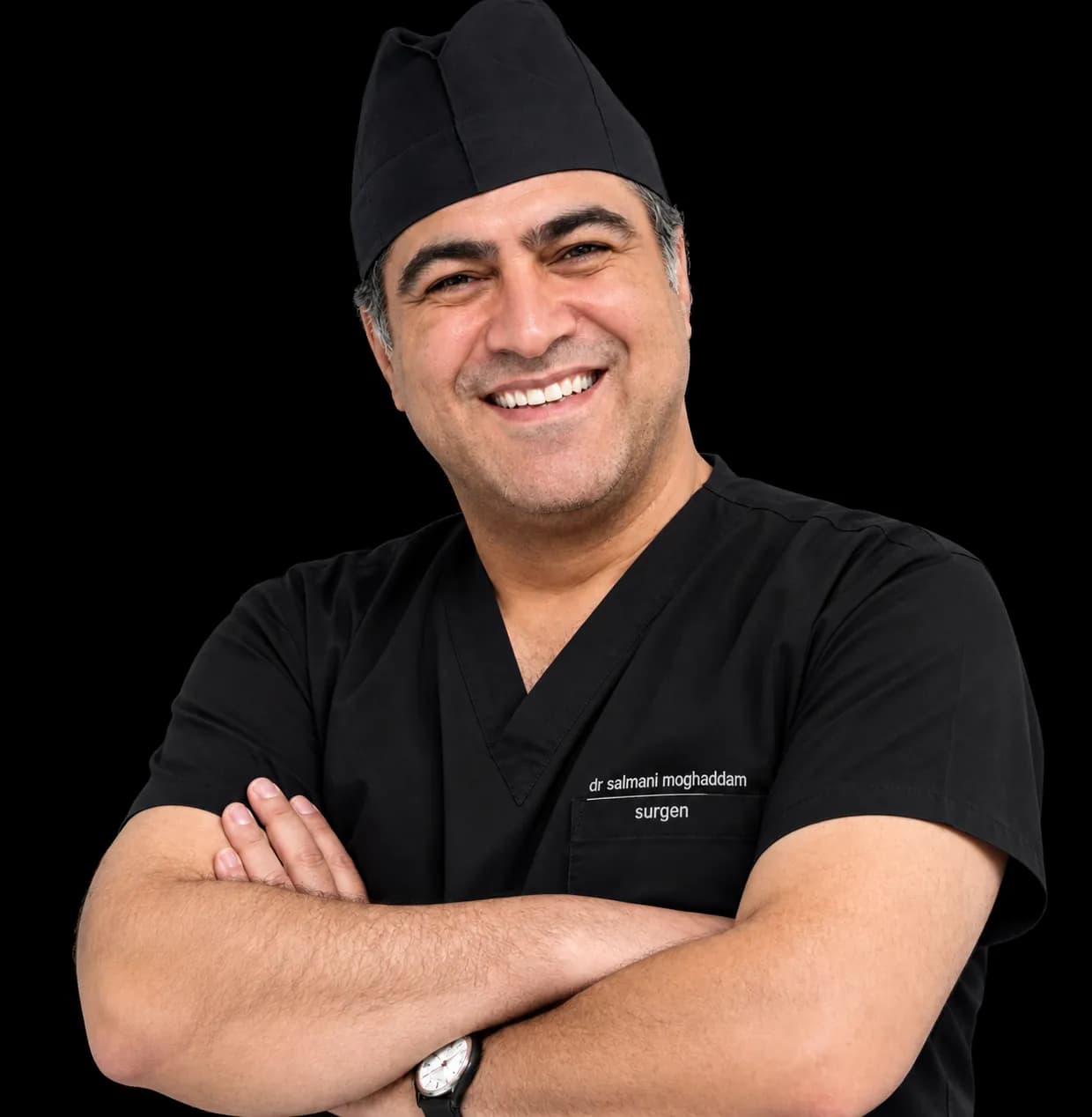
General Surgeon
Medical Council No.: 74530
Board-certified general surgeon focused on rhinoplasty, body contouring, abdominoplasty, VASER liposuction and aesthetic breast surgery.
- Board-certified general surgeon
- Member of the Iranian Medical Council
- Specialist in body contouring, VASER liposuction and aesthetic breast surgery
Medically reviewed by a physician
See the full profileQuestions about this procedure?
A consultation covers your own anatomy, what is realistically achievable, and what it involves.
Abdominoplasty (Tummy Tuck)Comments
No comments yet. Be the first to write one.
Related articles
Abdominoplasty With a Cesarean: Why Most Surgeons Say No
Combining abdominoplasty with a cesarean is technically done at some centers, but most surgeons avoid it: the abdominal wall is still swollen and changing, and combining two major surgeries raises bleeding, infection, and clotting risk.
Read moreAbdominoplasty After Childbirth: How Many Months to Wait
The right timing for abdominoplasty after childbirth is usually 6 to 12 months, once weight has been stable for at least three months, breastfeeding has ended, and no future pregnancy is planned. All four conditions must hold at once.
Read morePost-C-Section Belly Sag: What Exercise Can't Fix
Post-cesarean belly sagging comes from three separate causes: weak muscle tone, diastasis recti, and loose skin. Exercise restores tone and mild diastasis, but it cannot tighten overstretched skin or close a wide muscle gap.
Read more