
Post-C-Section Belly Sag: What Exercise Can't Fix

In short
Post-cesarean belly sagging comes from three separate causes: weak muscle tone, diastasis recti, and loose skin. Exercise restores tone and mild diastasis, but it cannot tighten overstretched skin or close a wide muscle gap.
What Actually Causes Belly Sagging After a Cesarean?
Belly sagging after a C-section usually comes from three distinct mechanisms: weakened core muscle tone, diastasis recti (separation of the two rectus abdominis muscles along the midline), and loose skin from nine months of sustained stretching. Each responds differently to exercise, and the common mistake is expecting one workout routine to fix all three. This article is educational and does not replace an in-person medical evaluation — pinpointing which cause applies to you requires an exam.
Why Does the Belly Stay Sagging After a C-Section?

During pregnancy, the abdominal wall is under continuous stretch for nine months; the skin's collagen and elastin fibers, the connective ligaments supporting the muscles, and the subcutaneous fat layer all undergo structural change. A cesarean adds a fourth layer: scar tissue above and below the abdominal fascia that changes local movement patterns and elasticity on its own.
Skin Stretching and Lost Elasticity
The skin over the front of the abdomen stretches to several times its normal size during pregnancy. According to the American Society of Plastic Surgeons (ASPS), once this stretch exceeds the elastin fibers' capacity to spring back, the skin stays permanently loose — a structural change that weight loss or muscle training cannot reverse, because the problem sits in the skin layer, not the muscle beneath it.
Diastasis Recti: The Rectus Muscles Pull Apart
Diastasis recti is the separation of the two rectus abdominis muscle bands from the midline (linea alba) under pregnancy stretch. According to the Cleveland Clinic, this separation is visible in roughly two-thirds of women immediately after delivery, and in many cases it narrows on its own within the first 8 weeks. The issue begins when that gap still exceeds about 2 to 3 centimeters after the initial recovery window closes.
Cesarean Scar Tissue and Fat Layer Changes
A cesarean incision cuts through skin down to the fascia, and during healing, scar tissue replaces part of the natural fiber network. Unlike healthy skin and muscle, scar tissue has no true elasticity and can adhere to the surrounding subcutaneous fat, sometimes creating a visible bulge or dip above the incision line — a texture change that abdominal exercise does not correct.
What Does Exercise Actually Bring Back?

Exercise genuinely improves two components of belly sagging: weakened muscle tone and mild diastasis recti. Both are muscular in nature rather than skin-based, and unlike stretched skin, muscle tissue has real capacity to rebuild strength and partially regain its original length.
Core Muscle Tone and General Fat
After nine months of relative inactivity and stretch, the abdominal muscles lose tone. Targeted strengthening — particularly core-stability work like modified planks, diaphragmatic breathing, and transverse abdominis activation — measurably restores muscle tone within a few months, according to postpartum physical therapy literature. Combining aerobic exercise with balanced nutrition also reduces overall subcutaneous fat, which lowers abdominal volume; this loss happens across the whole body, though, not only at the belly.
Mild to Moderate Diastasis
According to the American College of Obstetricians and Gynecologists (ACOG), in mild to moderate diastasis — typically a gap under 2 to 3 centimeters — targeted transverse abdominis training and avoiding load-bearing moves like classic crunches can narrow the gap to an acceptable degree within the first months. This kind of improvement is more likely after a first pregnancy and at a younger age, when connective tissue quality is still relatively preserved.
What Exercise Does Not Bring Back

Three things do not return to their pre-pregnancy state through any training program, regardless of intensity or duration: overstretched excess skin, moderate-to-severe diastasis recti, and scar tissue. This is a biological limit, not a matter of insufficient effort or a poorly designed routine.
Excess and Sagging Skin
Skin whose elastin fibers have been permanently overstretched does not return to its original thickness and firmness even with full weight loss and muscle building, because the problem lies in the skin's own structure, not the volume beneath it. According to ASPS, this type of skin laxity — especially after multiple pregnancies or significant stretch — is corrected only by surgically removing the excess skin, i.e., abdominoplasty.
Moderate to Severe Diastasis
When the gap between the rectus muscles remains wider than about 2 to 3 centimeters after the normal recovery window (roughly 8 to 12 weeks), plastic surgery literature notes that exercise no longer closes the gap, because the midline linea alba has stretched and thinned to a point where the muscle has no structural anchor to pull back toward. In these cases, repairing the fascia typically requires surgical suturing — the muscle plication performed as part of an abdominoplasty.
Scar Tissue and Local Adhesion
Cesarean scar tissue is not living tissue that remodels with training; its fiber arrangement and elasticity permanently differ from the surrounding skin and fascia. A bulge or dip above the incision caused by this adhesion is corrected only through surgical revision of the scar tissue, usually performed during the same abdominoplasty procedure.
Comparison Table: What Responds to Exercise vs. Surgery

The table below maps the three causes of belly sagging against the two correction paths — exercise and abdominoplasty. This is a general framework; the final decision always depends on an individual exam.
| Cause of Sagging | Responds to Exercise | Needs Surgery |
|---|---|---|
| Weak muscle tone | Yes | Usually no |
| Mild diastasis (under 2 cm) | Improves substantially | Usually no |
| Moderate-severe diastasis (over 2-3 cm) | Partial improvement only | Yes, fascia plication |
| Loose, sagging skin | No structural change | Yes, skin excision |
| Scar tissue and adhesion | No change | Yes, local revision |
When Is Exercise Not Enough? Considering Abdominoplasty

If, after at least 6 to 12 months of regular exercise and stable weight, a bulge below the navel, a noticeable gap between the two sides of the abdominal muscle, or hanging excess skin is still visible, the underlying issue is most likely a permanent muscular or skin problem rather than a lack of training. At this point, a specialist exam can measure the inter-muscular gap (usually by palpation or ultrasound) and distinguish diastasis from simple skin laxity.
Signs That Warrant a Specialist Evaluation
- A visible midline bulge below the navel when lifting the head from a lying position — the classic sign of residual diastasis.
- Skin that does not spring back under finger pressure and appears as a persistent fold or hanging flap.
- Chronic lower back pain or a sense of core instability that does not improve with core-stability exercises — significant diastasis can mean the abdominal wall has lost its natural support function.
At Dr. Salmani's practice, these signs are assessed through a direct exam before recommending either continued exercise or surgery, since the right path depends entirely on whether the issue originates in the muscle or the skin. For the appropriate timing window for abdominoplasty after childbirth, see Abdominoplasty After Childbirth.
What Abdominoplasty Fixes That Exercise Cannot

Abdominoplasty accomplishes three things simultaneously that are beyond the reach of exercise: removing overstretched excess skin, suturing and bringing together the two edges of the rectus abdominis muscle in residual diastasis (fascia plication), and, in many cases, repositioning the navel to a natural location. Full procedure details are available on the Abdominoplasty page.
This is major surgery and carries its own possible complications — including bleeding, infection, and delayed wound healing — which is why it is typically recommended only once the patient's weight has been stable for several consecutive months and no future pregnancy is planned. When localized fat around the area also needs addressing alongside abdominoplasty, Liposuction explains the techniques used for that.
Frequently Asked Questions
Does belly sagging after a C-section fully resolve with exercise?
Not always. Exercise improves muscle tone and mild-to-moderate diastasis, but it does not reverse permanently overstretched skin or severe diastasis — those components are usually corrected only through abdominoplasty.
What helps the belly tighten after childbirth?
Combining core-stability exercises (modified planks, transverse abdominis activation), balanced nutrition for gradual weight loss, and regular walking is the best starting point; if there is no noticeable result after a few months, a specialist exam can identify the remaining cause.
How can diastasis recti be checked at home?
Lie on your back with knees bent, and as you slowly lift your head and shoulders, place two fingers on the midline of your abdomen above the navel. If you feel a gap wider than two finger-widths, diastasis recti is likely and should be evaluated by a doctor.
How soon after a C-section is it safe to start abdominal exercise?
Gentle breathing work and transverse abdominis activation are usually started within the first weeks with a doctor's approval, but more intense abdominal exercises are typically postponed until the initial recovery period ends (usually 6 to 8 weeks) and the cesarean incision has fully healed.
Does a belly that stays large after a C-section always mean diastasis?
Not necessarily. A belly that stays enlarged can stem from general fat accumulation, loose skin, weak muscle tone, diastasis, or a combination of these four factors. Only a direct exam can determine how much each one contributes.
When to See a Doctor

If, after roughly 6 months of regular exercise, a visible muscle gap, a bulge below the navel, or hanging skin is still present — or if lower back pain and a sense of core instability persist — consulting a general surgery specialist is the logical next step. An in-person exam will determine whether the issue can still be resolved with continued physical therapy or requires evaluation for abdominoplasty. Current pricing for this procedure is listed on the services page.
Sources
This article is educational and does not replace an in-person examination or consultation. Discuss any surgical decision with your own physician.
About the author
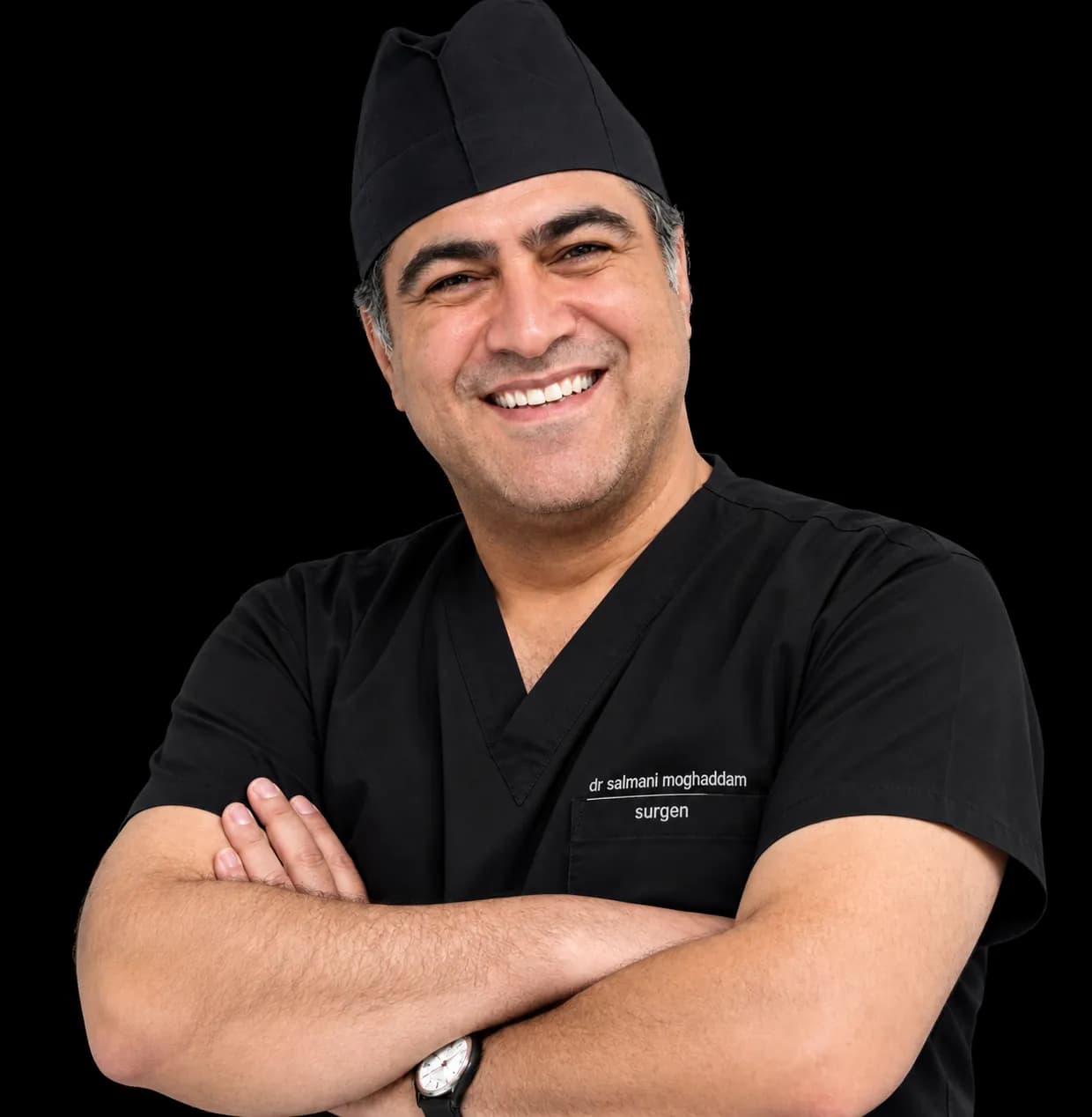
General Surgeon
Medical Council No.: 74530
Board-certified general surgeon focused on body contouring, abdominoplasty, VASER liposuction and aesthetic breast surgery.
- Board-certified general surgeon
- Member of the Iranian Medical Council
- Specialist in body contouring, VASER liposuction and aesthetic breast surgery
Medically reviewed by a physician
See the full profileQuestions about this procedure?
A consultation covers your own anatomy, what is realistically achievable, and what it involves.
Abdominoplasty (Tummy Tuck)Comments
No comments yet. Be the first to write one.
Related articles
Abdominoplasty With a Cesarean: Why Most Surgeons Say No
Combining abdominoplasty with a cesarean is technically done at some centers, but most surgeons avoid it: the abdominal wall is still swollen and changing, and combining two major surgeries raises bleeding, infection, and clotting risk.
Read moreAbdominoplasty After Childbirth: How Many Months to Wait
The right timing for abdominoplasty after childbirth is usually 6 to 12 months, once weight has been stable for at least three months, breastfeeding has ended, and no future pregnancy is planned. All four conditions must hold at once.
Read moreAbdominoplasty After Gastric Sleeve: Timing & Readiness
Abdominoplasty after gastric sleeve surgery is typically performed 12 to 18 months post-op, once weight has held steady. Operating earlier means shaping a body still changing, raising the risk of wound-healing problems and returning skin laxity.
Read more