Walking Hunched After a Tummy Tuck: How Long Does It Last?

In short
Most people walk bent forward for a few days to about two weeks after a tummy tuck; the ASPS says standing fully upright usually returns within one to two weeks. Exact timing depends on closure tension and your surgeon's technique.
Why do you walk bent forward after abdominoplasty?
You walk bent forward after abdominoplasty because the lower abdominal skin has been pulled down and stitched, and standing fully straight stretches that closure. The American Society of Plastic Surgeons (ASPS) notes that the final result is first hidden by swelling and by being unable to stand fully upright until internal healing is complete. This article is educational and does not replace your surgeon's instructions.
Tension on the incision line
During abdominoplasty the skin and fat above the navel are lifted off the abdominal wall, the excess is removed, and the upper edge is stitched to the lower edge near the underwear line. When you stand fully straight, the hips and pelvis pull the body backward and the incision feels the most stretch. Bending slightly at the hips shortens that distance and takes strain off the stitches, which is why most people find it more comfortable.
Tightened muscle and a firm feeling
If the two rectus muscles were also stitched together (plication), the abdominal wall is firmer than before. In a study of 10 women, average pressure inside the abdomen rose from 6.6 to 9.3 mmHg after plication, and the authors did not consider this clinically important in healthy people. It is reasonable to think this extra firmness makes standing fully straight feel unpleasant in the first days, but that study did not examine walking posture directly.
How many days until you can stand straight again?
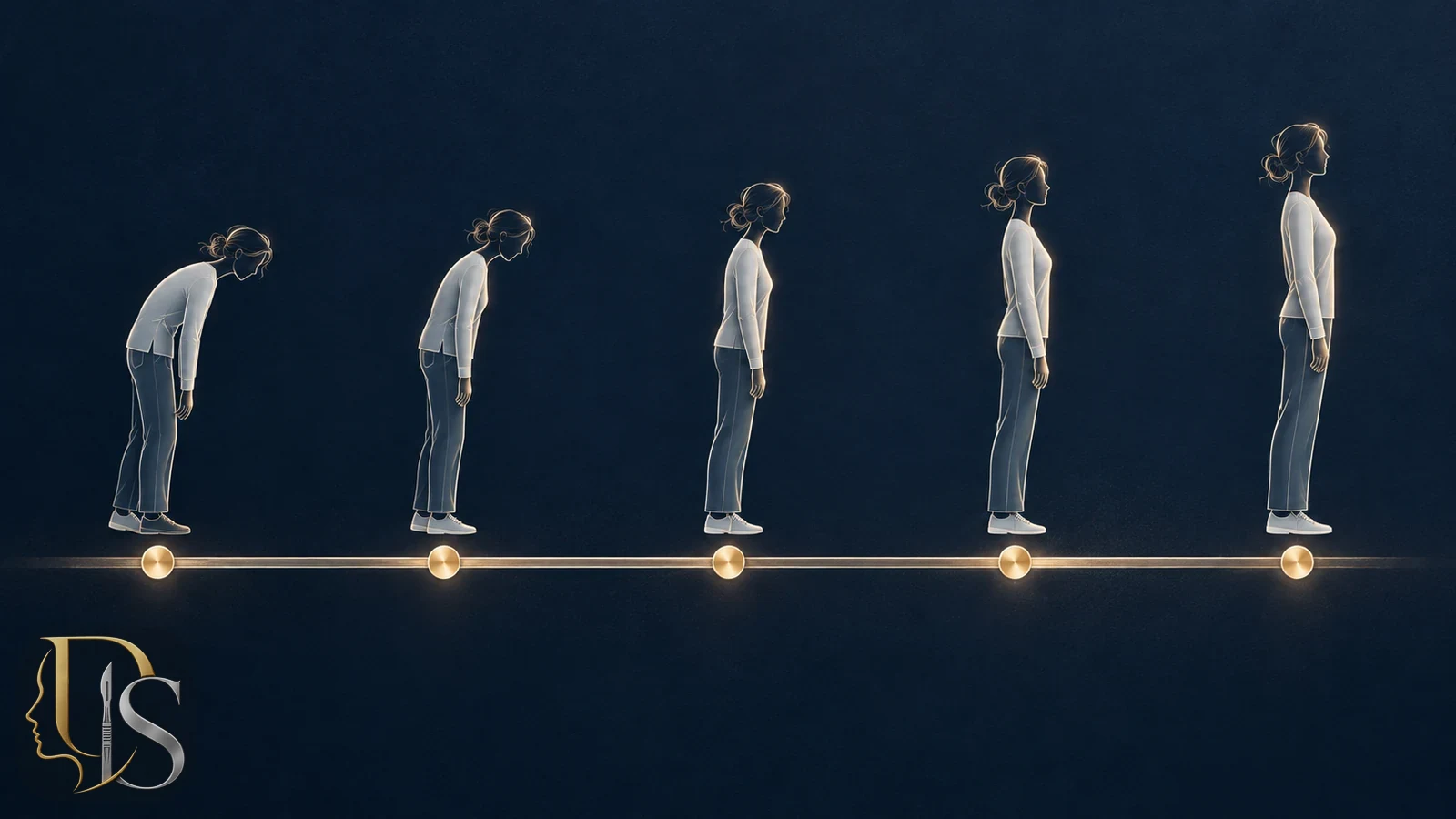
Most patients straighten up gradually over a few days to about two weeks. ASPS says that within a week or two you should be standing tall again. Clinics give different numbers, and that difference is real: there is no single proven figure, so the instruction from your own surgeon is the one that counts.
A rough timeline
The table below is a general frame, not a prescription. Only the "one to two weeks" range comes directly from ASPS; the other rows summarise common experience and vary between surgeons and operations.
| Stage | Typical posture | Practical note |
|---|---|---|
| First 48 hours | Bent, short steps | Get up and walk with help |
| Day 3 to day 7 | Slowly less bent | Short walks around the home every few hours |
| Week 2 | Close to upright | Strong stretch still feels unpleasant |
| After week 2 | Usually upright | If you still cannot straighten, tell your surgeon |
What lengthens or shortens the period?
The type of operation matters. A mini abdominoplasty, which treats only the area below the navel, usually involves less tension than a full or extended operation; our article on mini abdominoplasty explains the difference. The amount of skin removed, muscle tightening, body weight, age and pain tolerance also play a part. No table replaces your own examination.
Why do surgeons give different timelines?

Surgeons give different timelines because we found no trial that compares walking bent with walking upright after abdominoplasty, so instructions rest mostly on experience and on how the wound was closed. Our PubMed searches did not find a direct comparison. A number from your surgeon reflects that team's experience and can be perfectly reasonable.
Progressive tension sutures and low-tension closures
With progressive tension sutures the skin is anchored to the tissue beneath at several points so that less pull falls on the main incision. A report in Clinics in Plastic Surgery (2004) describing the technique says no drains are used and early ambulation in an upright posture is encouraged. So "you must stay bent" is not the same advice in every technique.
Habit or necessity?
Some advice is traditional and has no strong direct evidence behind it. The most useful question for your surgeon is: "With your technique, how long should I stay bent, and what tells me I can straighten more?"
The right way to walk in the first days

In the first days, bend slightly forward from the hips rather than the back or neck, take short steps, and walk briefly several times a day. The aim is not to force your body upright; it is to move without painful pull on the incision. Your surgeon gives the exact instructions.
Getting out of bed and sitting down
- Roll to your side first: hang your legs off the bed and push up with your arms instead of using your abdominal muscles.
- Have help for the first few times: dizziness after anaesthesia and medication is common.
- Sit in a half-reclined position: choose an angle at which the incision is not pulled.
Why staying in bed is risky
Abdominoplasty is among the aesthetic operations most strongly linked with venous thromboembolism (blood clots in the veins). In outpatient surgery-centre data, 240 of 414 clot events (about 58%) followed abdominoplasty, and age over 40 and a body mass index above 25 were predictors. A pooled review of 1,596 patients found an overall clot rate of 0.56%. The risk is low, but short, frequent walks are one of the simplest preventive measures. In one study, activity after abdominal wall surgery reached about 64.6% of the pre-operative level by day 14, which shows how gradual recovery is.
Staying bent too long and standing straight too early both cause problems

Neither staying heavily bent for too long nor forcing yourself upright is recommended. Prolonged bending causes back and hip stiffness, while forcing the posture early produces painful pull on the incision. ASPS stresses that incisions should not be exposed to excessive force, swelling or motion during healing.
A sign you may be ready to straighten more
If you do not feel a sharp, burning pull along the incision when you stand, you can straighten a little more. If every attempt brings strong pain, take shorter steps and try again tomorrow. Progress is usually small but noticeable from day to day.
Problems that come from too much tension
Wound edge separation, fluid collecting under the skin (seroma) and slow wound healing are all on the ASPS list of abdominoplasty risks. Reported seroma rates in reviews range from 5% to 43%, depending on technique and follow-up. This does not mean ordinary walking causes seroma; it means that new fluid, discharge or one-sided swelling should be reported to your surgeon quickly.
Back pain, stiffness and a crooked gait: what is normal?

Some stiffness in the back and buttocks during the first week is common while your body adapts. Over the longer term the picture is reversed: in a study of 40 women with back pain, spinal angles and pain improved six months after abdominoplasty with muscle plication.
Easing the stiffness
- Short, frequent movement: long sitting or lying still makes stiffness worse.
- A pillow under the knees: lying down this way reduces pull on the abdomen.
- Painkillers only as your surgeon directs: some drugs raise bleeding risk.
- No hot-water bottle on the abdomen: the skin may have reduced sensation after surgery, and burns can happen without you feeling them. See our article on numbness of the abdominal skin after abdominoplasty.
One hip higher or one side more bent
A little asymmetry in the first days is normal, because swelling can be heavier on one side. If after two weeks one side is clearly higher or one side of the abdomen is noticeably more prominent, show your surgeon.
Who may straighten up more slowly?
People with a larger resection, wider muscle tightening or a combined operation may stay bent a few days longer than average. This is not a fixed rule, but the logic is simple: the more skin that is advanced and the more muscle that is tightened, the more tension on the tissue.
Extended and combined operations
Extended or fleur-de-lis abdominoplasty involves a wider incision and pull; our article on extended and fleur-de-lis abdominoplasty explains these operations. When abdominoplasty is combined with liposuction or another procedure in one session, swelling and pain can be greater, and surgeons usually give a more cautious plan.
Weight and other health factors
A systematic review and meta-analysis in Aesthetic Plastic Surgery (2024) found that in cosmetic abdominal body contouring, obesity (BMI of 30 or above) was linked with more seromas (odds ratio 1.45) and more haematomas (odds ratio 2.21). The authors stressed that obesity is not an absolute bar to surgery and that each patient should be assessed individually. If your risk is higher, your surgeon may plan walking more conservatively.
Previous caesarean, hernia and earlier surgery
An old caesarean scar is usually incorporated into the new incision (ASPS). If a navel or abdominal hernia was repaired in the same session, your surgeon may give different restrictions. Comparing yourself with a friend or online forum stories is usually misleading.
Sleeping, sitting, stairs and travel
For the first days it is best to keep the slightly bent position while sleeping and sitting as well: raise your back and knees so the abdomen is not stretched. Your surgeon specifies the details, but the logic is the same everywhere: the incision line should not be pulled.
Sleep in the first week
- Slightly propped up: pillows under the back and knees usually reduce pull.
- Turn carefully: roll your whole body together rather than twisting at the waist.
- Do not lie on your stomach: until your surgeon allows it, pressure on the abdomen and incision is unhelpful.
Sitting, driving and stairs
Low seats that fold the abdomen sharply are uncomfortable. Postpone driving while you take sedating medication or strong painkillers, and until you can use pedals and wheel and brake suddenly without painful pull; ask your surgeon for the date. Take stairs slowly with a hand on the rail.
If you are travelling for surgery
Patients who come from abroad often ask when they can fly home. Long periods of sitting raise clot risk in general, so ask your surgeon before booking a return flight, and plan to stand, walk and move your ankles regularly on the journey. Sending your surgeon clear photos of the incision and describing your posture and pain helps remote follow-up, but it does not replace an examination if something looks wrong.
Signs you should not ignore while walking
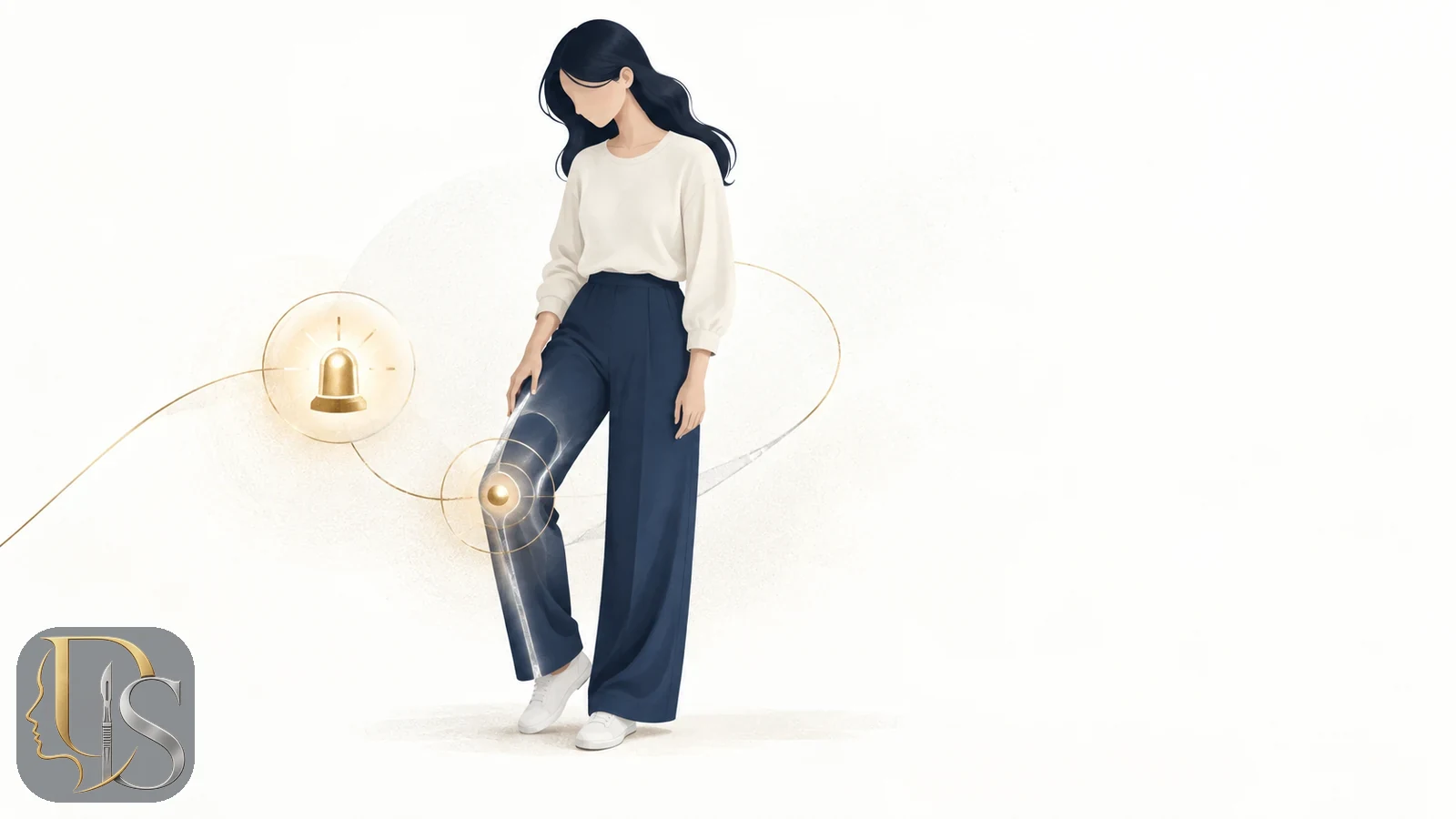
Pain or swelling in one calf, shortness of breath, chest pain and high fever are warning signs; seek medical help immediately. Mild to moderate pain along the incision with walking is normal, but anything sudden, severe or one-sided needs to be seen. Call your surgeon too, but for breathing difficulty or chest pain go to emergency care first.
Leg and lung signs
- Leg: pain, warmth, redness or swelling of one leg that differs from the other.
- Lung: sudden breathlessness, sharp pain on breathing, or coughing blood.
- Heart rate: a pounding heartbeat or sudden dizziness.
Wound signs
- High fever or chills: may suggest infection.
- New discharge or an unpleasant smell: from the incision or navel.
- Darkening or dusky colour at the wound edge: may mean poor blood supply.
- A sudden, firm swelling on one side of the abdomen: could be a collection of blood or fluid.
Frequently Asked Questions
How many days after a tummy tuck can you walk upright?
Most patients reach an upright posture between a few days and about two weeks, and ASPS cites "a week or two". It is often earlier after a mini abdominoplasty and sometimes later after an extended one. If you still cannot straighten without severe pain after two weeks, tell your surgeon.
Is walking bent forward really necessary?
There is no strong direct evidence that it is required, but reducing tension on the stitches is logical and many surgeons recommend it. With low-tension techniques such as progressive tension sutures, early upright walking is also encouraged. The best approach is to follow your own surgeon's instructions.
How often and how far should I walk?
Your surgeon gives exact instructions, but the usual pattern is short, frequent walks around the house rather than one long walk. The goal is gentle movement for circulation. Exercise and brisk walking must wait; a gradual plan is in our article on exercise after abdominoplasty.
Does the compression garment change how I walk?
A garment can feel supportive and some patients are more comfortable in one, but the evidence for its effect is weak and your surgeon sets the duration. The full discussion is in our article on compression garments after abdominoplasty.
My back hurts and I cannot stand straight. What should I do?
Mild stiffness is normal. If the pain is severe, you notice weakness or numbness in the legs, or two weeks have passed with no improvement, tell your surgeon. Do not force yourself straight.
When should you consult a doctor
If after two weeks you still cannot straighten with tolerable pain, one side of the abdomen has suddenly swollen, or you have leg or lung warning signs, contact your surgeon. If you are considering abdominoplasty, the abdominoplasty page explains the consultation process, and current costs are on the services and pricing list. This article is educational and does not replace an in-person examination.
Sources
- ASPS — Tummy Tuck Recovery
- ASPS — Tummy Tuck Results
- ASPS — Tummy Tuck Risks and Safety
- NCBI / StatPearls — Abdominoplasty
- Clinics in Plastic Surgery, 2004 — Progressive tension sutures in abdominoplasty
- Aesthetic Surgery Journal, 2018 — Incidence and Predictors of Venous Thromboembolism in Abdominoplasty
- Aesthetic Surgery Journal, 2021 — Venous Thromboembolism and Bleeding Events With Chemoprophylaxis in Abdominoplasty
- Aesthetic Surgery Journal, 2016 — Effects of Abdominoplasty on Intra-Abdominal Pressure and Pulmonary Function
- Aesthetic Surgery Journal, 2016 — Improvements in Vertebral-Column Angles and Psychological Metrics After Abdominoplasty With Rectus Plication
- JPRAS, 2024 — Quantifying postoperative recovery using wearable activity monitors following abdominal wall surgery (AbTech)
- Aesthetic Plastic Surgery, 2024 — Obesity as a Risk Factor in Cosmetic Abdominal Body Contouring: A Systematic Review and Meta-Analysis
- Aesthetic Plastic Surgery, 2025 — Therapeutical Strategies to Prevent Abdominoplasty Complications: A Systematic Review
This article is educational and does not replace an in-person examination or consultation. Discuss any surgical decision with your own physician.
About the author
General Surgeon
Medical Council No.: 74530 · Verify in the Medical Council register
Specialist in general surgery focused on rhinoplasty, body contouring, abdominoplasty, VASER liposuction and aesthetic breast surgery.
- Specialist in general surgery
- Member of the Iranian Medical Council
- Specialist in body contouring, VASER liposuction and aesthetic breast surgery
Medically reviewed by a physician
See the full profileQuestions about this procedure?
A consultation covers your own anatomy, what is realistically achievable, and what it involves.
Abdominoplasty (Tummy Tuck)Comments
No comments yet. Be the first to write one.
Related articles
Abdominoplasty Cost in Tehran: What the Bill Really Contains
The cost of an abdominoplasty is the sum of separate lines: surgeon, anesthesia, hospital, tests, garment and medication. An advertised figure may include only some of them, so compare two quotes line by line rather than by the total alone.
Read moreExtended vs Fleur-de-Lis Abdominoplasty: When Vertical Is Needed
An extended abdominoplasty carries the incision toward the flanks to remove tissue beside the hips. Fleur-de-lis adds a vertical incision for skin loose both across and along the abdomen, typically after major weight loss.
Read moreMini Abdominoplasty: What It Is and Who Is Truly a Candidate
A mini abdominoplasty removes only skin and fat below the navel. A good candidate has stable weight and laxity confined to the lower belly; loose skin above the navel or a wide muscle gap usually needs a full tummy tuck.
Read more